

How Game Developers Use Axon by Applovin to Scale User Acquisition
How Game Developers Use Axon by Applovin to Scale User Acquisition
AppLovin’s Axon helps mobile game developers scale user acquisition by predicting player value, optimizing bids in real time, and adapting to SKAN limitations—all without relying on personal identifiers. Built by a team with deep roots in both mobile advertising and mobile gaming, Axon is designed to improve ROAS, reduce CPI, and automate creative rotation—making it a powerful tool for studios navigating privacy constraints and rising acquisition costs.
Every game studio wants growth yet few have the infrastructure to scale it. Axon was built to close that gap.
User acquisition in mobile gaming starts with installs, but the real story unfolds after the download — when players either disappear forever or become part of the game’s economy. We want users who stay, spend, and shape the long-term health of a game. That’s harder than ever in a world of rising CPIs, fragmented attribution, and disappearing identifiers. AppLovin’s Axon was built to solve this. It’s not a bolt-on feature or a generic optimization layer. It’s the decisioning engine at the core of AppLovin’s ad stack, designed to help game developers scale intelligently.
This article breaks down how Axon works, why it matters for mobile game studios, and what strategies actually move the needle when it’s part of your UA stack.
What Is Axon by Applovin and Why Game Developers Use It
Axon is a machine learning platform trained on billions of ad interactions, installs, and post-install events. It doesn’t rely on IDFA or personal identifiers. Instead, it uses contextual signals — device type, OS version, app category, session depth — to forecast which users are likely to engage, convert, and retain.
That matters for game developers. Predicting player value before the install means campaigns can bid more aggressively on high-LTV users and pull back when the signals look weak.
*High-LTV (Lifetime Value) users who generate significant revenue over time—whether through in-app purchases, ad engagement, or long-term retention. These players don’t just install the game; they contribute meaningfully to its monetization and growth. Axon prioritizes acquiring high-LTV users by predicting their value before the install, using contextual signals instead of personal identifiers.
How Game Studios Use Axon
Axon is designed to help mobile game developers scale user acquisition by making data-driven decisions before and after the install. It forecasts player value using contextual signals and adjusts bidding in real time to prioritize users who are likely to retain or monetize. Axon does not rely on personal identifiers like IDFA. Instead, it uses privacy-compliant inputs to guide spend and improve ROAS.
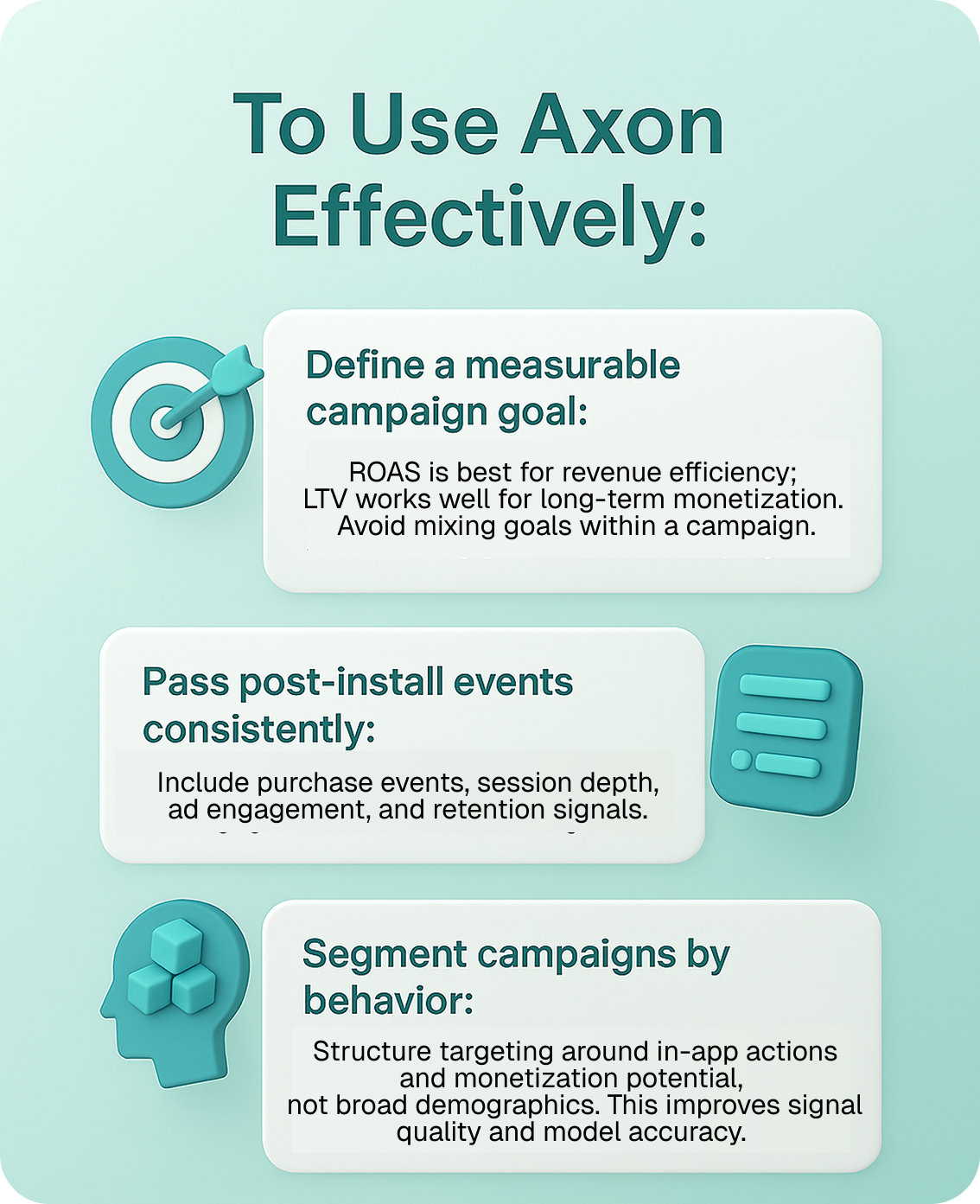
To use Axon effectively:
- Define a measurable campaign goal: ROAS is best for revenue efficiency; LTV works well for long-term monetization. Avoid mixing goals within a campaign.
- Pass post-install events consistently: Include purchase events, session depth, ad engagement, and retention signals. These help Axon refine its predictions and improve future bidding.
- Segment campaigns by behavior: Structure targeting around in-app actions and monetization potential, not broad demographics. This improves signal quality and model accuracy.
Campaigns perform best when they are built with clear objectives, consistent event tracking, and behavioral segmentation.
Creative Optimization: Keeping Ads Fresh and Effective
Creative performance directly affects install rates and post-install engagement. Axon automates creative rotation by monitoring engagement signals and suppressing underperforming variants. This reduces manual testing and helps campaigns stay efficient over time.
To maintain creative performance:
- Upload multiple variants per campaign: Include different gameplay clips, CTA styles, and visual themes.
- Refresh assets regularly: Update creatives every 1–2 weeks to prevent fatigue, especially in high-frequency formats like rewarded video.
- Localize for key markets: Tailor visuals and messaging to regional preferences to improve relevance and retention.
Axon uses real-time engagement data to prioritize high-performing creatives and reduce delivery of fatigued assets. The more variation and freshness you provide, the better the system can optimize.
Targeting and Attribution: What Axon Uses to Make Decisions
Axon was built to operate in environments with limited tracking. It does not depend on personal identifiers. Instead, it uses contextual and behavioral signals to guide delivery and bidding.
Key inputs include:
- Device type and OS version: These help model user behavior and compatibility.
- App category and session depth: Axon compares your game’s genre with user engagement patterns to estimate fit and retention likelihood.
- SKAN postbacks: Axon supports SKAN 4.0, including multi-window attribution and conversion values.
- Modeled conversions: When SKAN data is delayed or incomplete, Axon uses contextual inference to estimate ROAS and retention.
- Privacy-safe behavioral indicators: These include time of day, network speed, and engagement with similar apps.
Axon combines these signals to make real-time decisions about who to target, how much to bid, and which creatives to serve. This allows campaigns to remain responsive even when attribution data is partial or delayed.
Real-Time Bidding: Predicting Player Value Before the Install
Axon’s bidding engine is designed to make decisions before a user installs the game. Instead of waiting for post-install data, it uses contextual signals and historical patterns to estimate how valuable a user is likely to be. This allows campaigns to allocate spend more efficiently and avoid overbidding on low-value traffic.
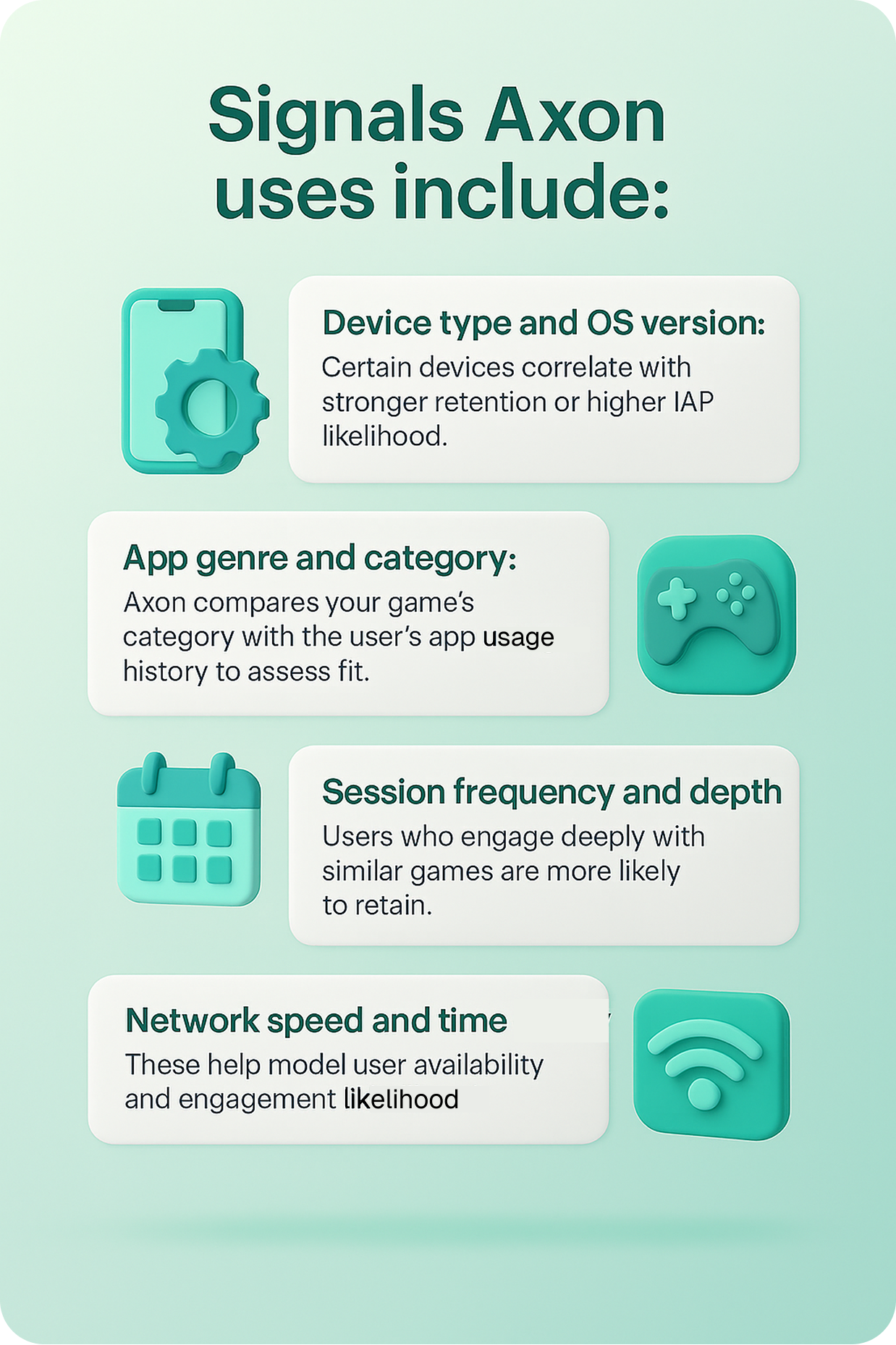
Signals Axon uses include:
- Device type and OS version: Certain devices correlate with stronger retention or higher IAP likelihood.
- App genre and category: Axon compares your game’s category with the user’s app usage history to assess fit.
- Session frequency and depth: Users who engage deeply with similar games are more likely to retain.
Network speed and time of day: These help model user availability and engagement likelihood.
If the forecast suggests strong retention or monetization potential, Axon bids more aggressively. If the signals indicate low engagement probability, it reduces spend or skips the impression entirely. This dynamic bidding helps studios scale efficiently while maintaining ROAS.
Best Practices for Game Studios Using Axon
Studios that get the most out of Axon treat it as a learning system. They launch campaigns with a structure designed to feed Axon the right inputs and adapt based on performance.
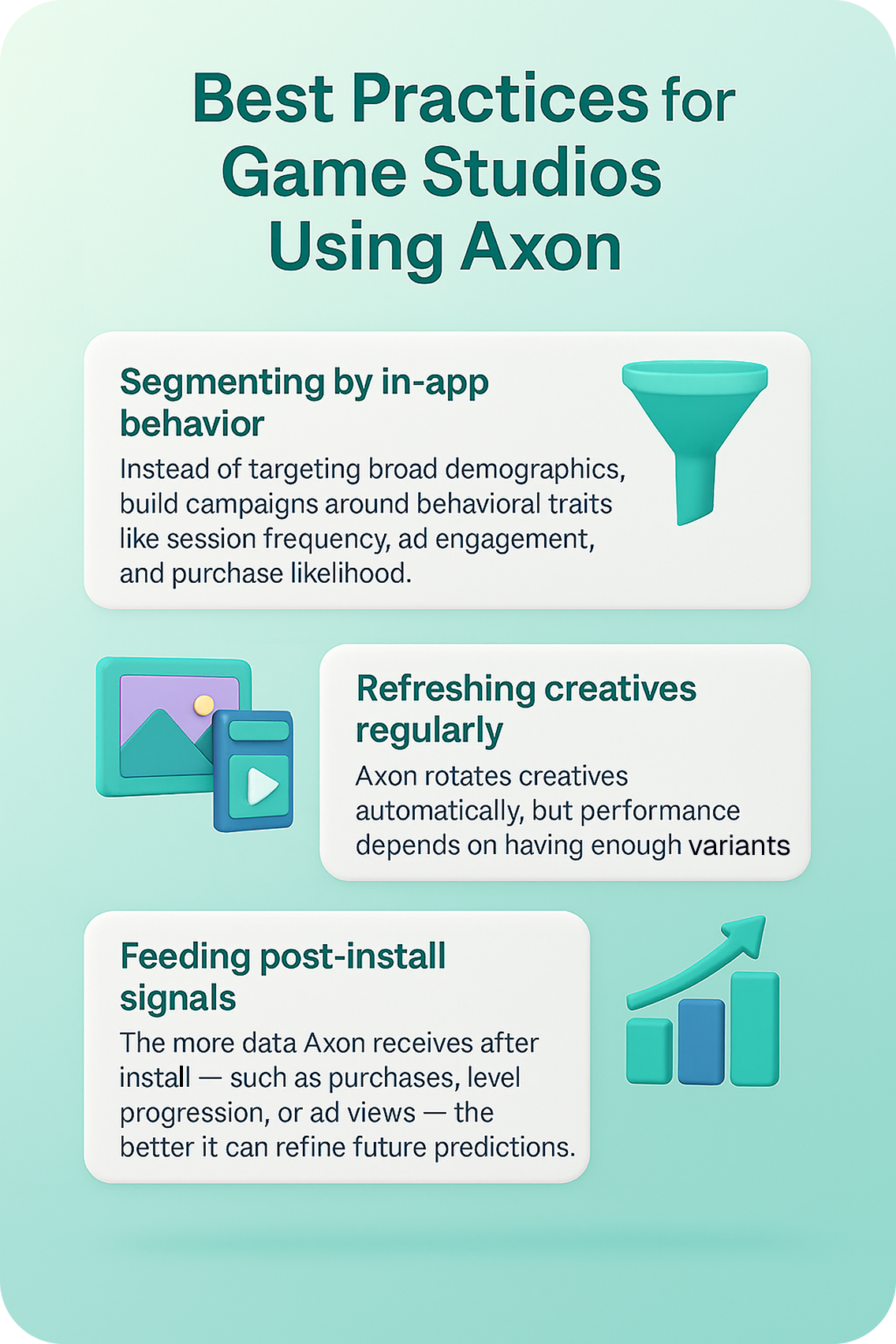
Key practices include:
- Segmenting by in-app behavior: Instead of targeting broad demographics, build campaigns around behavioral traits like session frequency, ad engagement, and purchase likelihood. This gives Axon clearer signals to model against.
- Refreshing creatives regularly: Axon rotates creatives automatically, but performance depends on having enough variants. Update assets every 1–2 weeks to prevent fatigue and maintain engagement.
- Feeding post-install signals: The more data Axon receives after install — such as purchases, level progression, or ad views — the better it can refine future predictions. Use SKAN postbacks and server-side events to ensure coverage.
Studios that align campaign structure, creative pipelines, and signal flow see stronger performance and more consistent ROAS.
Performance Benchmarks from Game Publishers
Game developers using Axon have reported measurable improvements in acquisition efficiency and campaign responsiveness.
- ROAS improvement within the first month: Studios saw 20–40% gains in return on ad spend after switching to Axon, driven by better pre-install forecasting and dynamic bidding.
- Lower CPI in SKAN-heavy environments: Axon’s ability to model conversions and fill attribution gaps led to a 15% reduction in cost per install, even when SKAN was the primary signal source.
- Faster creative fatigue detection: Axon identified underperforming creatives twice as fast as manual testing, allowing studios to suppress weak variants before they impacted performance.
These results reflect how Axon uses contextual modeling, real-time bidding, and automated creative rotation to optimize campaigns — even when attribution is delayed or incomplete.
Comparing Axon to Other Ad Platforms
Axon differs from other platforms by focusing on adaptive decision-making. It continuously updates its models and adjusts spend based on real-time signals. This makes it especially effective in privacy-constrained environments and SKAN-based attribution setups.
Game developers using Axon spend less to acquire users who retain longer, engage more deeply, and monetize more effectively.
Final Thoughts: Scaling UA with Intelligence
Axon helps game developers grow sustainably by aligning machine learning with real business outcomes. It adjusts delivery, bidding, and creative rotation based on real-time signals.
To succeed with Axon:
- Define a single campaign goal (ROAS or LTV)
- Ensure clean signal setup via SDK and SKAN
- Use mobile-first creatives with strong CTAs
- Test and iterate consistently
When campaign structure, signal quality, and creative strategy are aligned, Axon delivers measurable results. Scaling with Axon isn’t about spending more — it’s about spending smarter.
FAQs
What types of games benefit most from Axon? Axon performs well across genres, especially those with strong retention or monetization via IAP and ads.
Can Axon optimize for in-app purchases and ad revenue? Yes. Axon models both IAP and ad engagement to predict LTV and guide bidding.
How does Axon handle SKAN attribution? Axon supports SKAN 4.0, models missing conversions, and uses contextual signals to fill attribution gaps.
Is Axon compatible with Unity or Unreal Engine? Yes. Axon operates independently of game engines and integrates via AppLovin’s ad stack.
What data does Axon use to predict player value? Contextual signals like device type, session depth, app category, and historical engagement — all without personal identifiers.