

Mobile Attribution in Advertising: Models, Challenges, and Best Practices for 2026

Mobile Ad Attribution in 2026: Models, Challenges, and Best Practices
Let’s be clear: mobile ad attribution has become one of the toughest (and most important) parts of performance marketing in 2026. Costs are climbing, user journeys are scattered across platforms, and privacy rules keep tightening. In this environment, guessing which campaigns actually drive growth isn’t an option. Attribution is the lens that shows you where spend is working, where budgets should scale, and where ROI is real. Without it, even the smartest bidding strategies are built on shaky ground.
What Is Mobile Ad Attribution and Why Does It Matter?
At its core, mobile ad attribution is about connecting the dots: linking installs, purchases, or subscriptions back to the campaigns that influenced them. It matters because attribution decides who gets credit for growth, whether it’s a click, an impression, or a creative that sparked action. When attribution is off, budgets get misallocated: too much money flows into underperforming channels, while the campaigns actually driving incremental ROI get overlooked. Accurate attribution is the foundation for scaling spend with confidence.
How Does Mobile Ad Attribution Work?
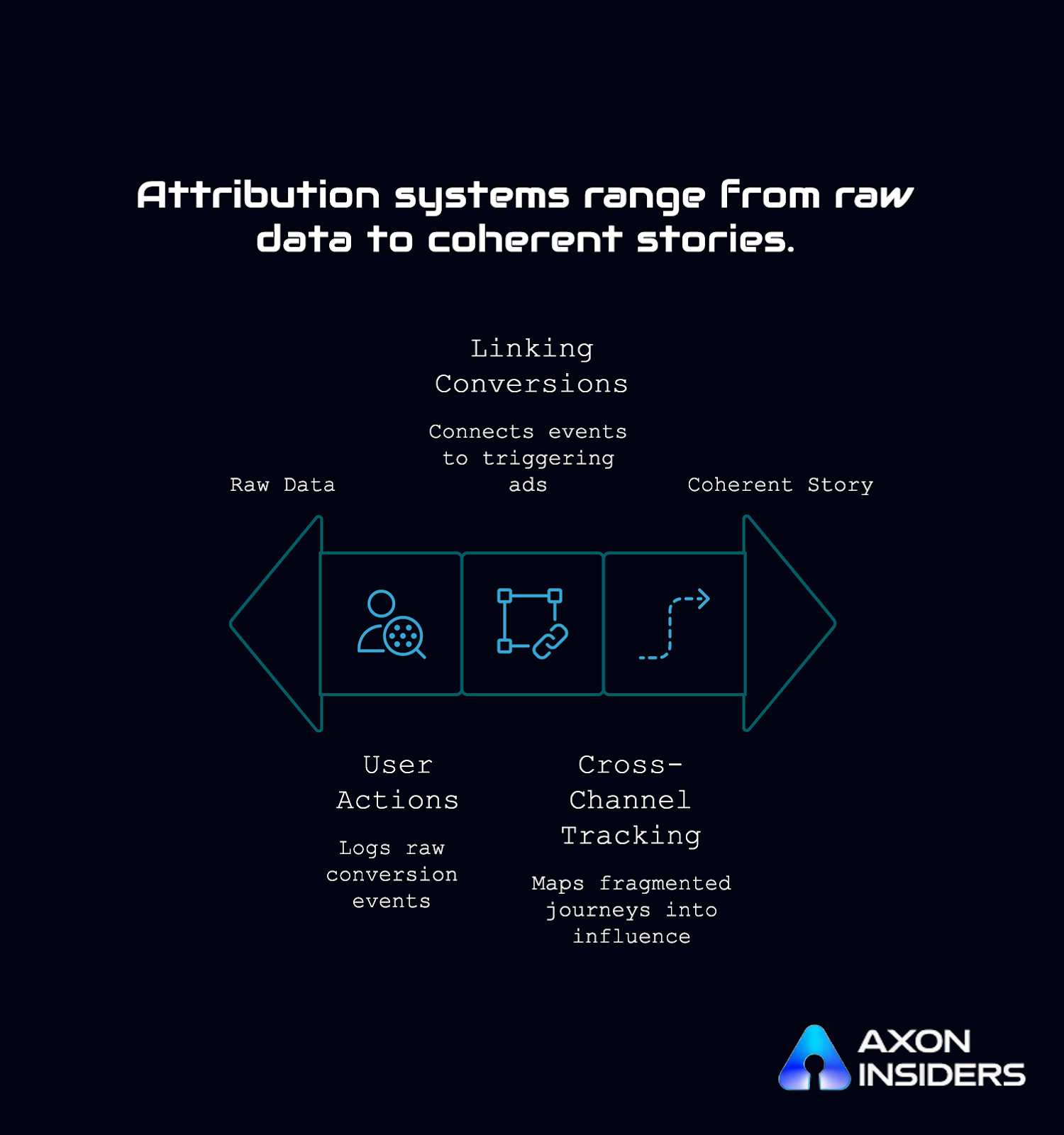
Attribution is essentially the detective work of performance marketing: figuring out which campaigns, creatives, or touchpoints actually influenced a user’s decision. In practice, it relies on a web of signals stitched together across devices and channels.
- User Actions: Every install, purchase, or subscription is logged as a potential conversion event. These are the raw clues.
- Linking Conversions: SDKs, pixels, and APIs act like connectors, tying those events back to the ads that may have triggered them. Without this infrastructure, conversions float unassigned, leaving advertisers blind.
- Cross‑Channel Tracking: The hardest part is stitching fragmented journeys together. A user might see a TikTok ad, click a Google search result, and finally convert after an Instagram retargeting ad. Attribution systems attempt to map that messy path into a coherent story of influence.
The challenge is that in 2026, signal loss and privacy restrictions mean this detective work is often incomplete. Advertisers must rely on models and probabilities rather than perfect tracking.
What Are the Main Mobile Attribution Models?
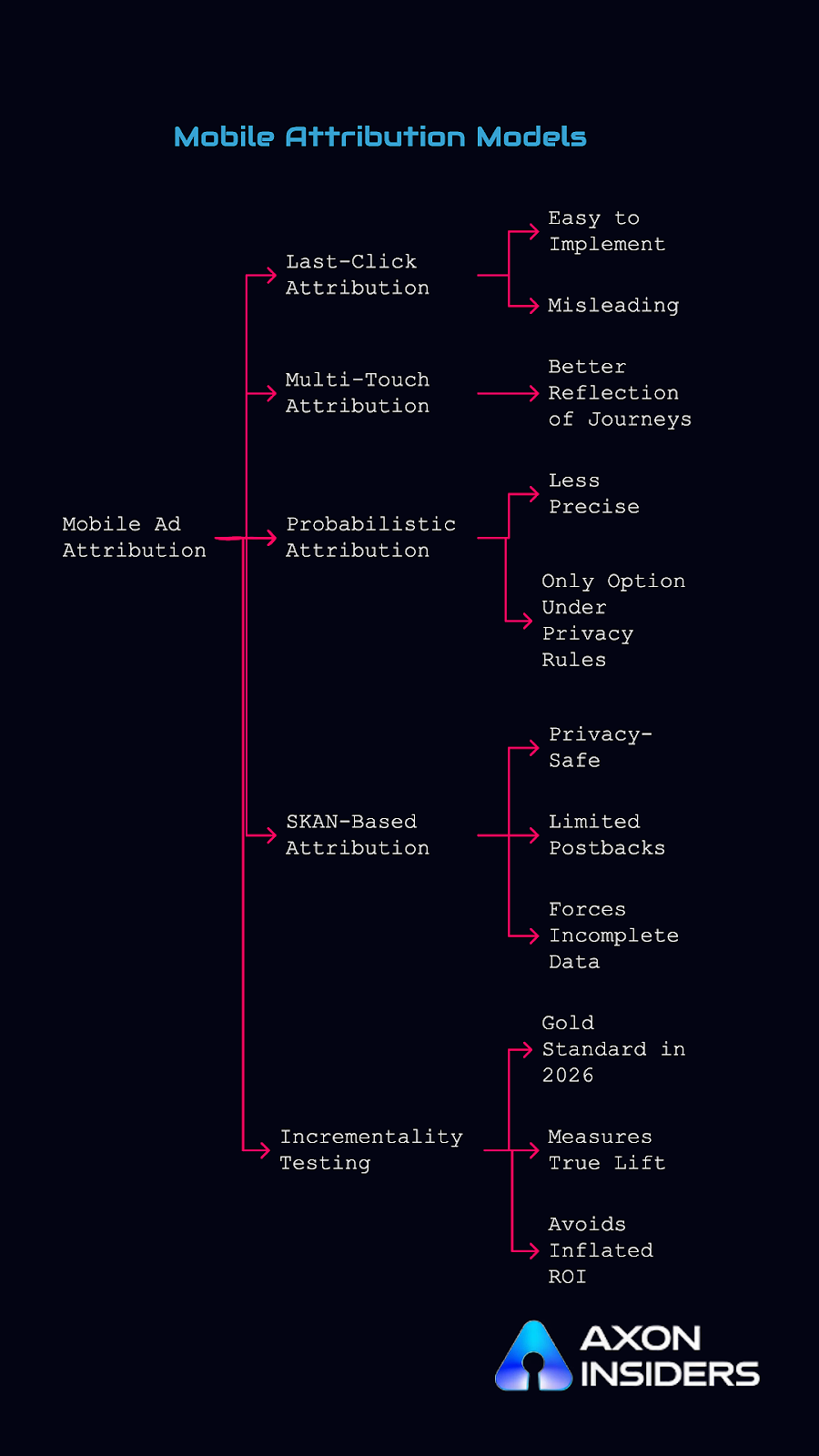
Different models try to answer the same question: who gets credit for the conversion? But they do it in very different ways:
- Last‑Click Attribution: The simplest model, crediting the final touchpoint before conversion. It’s easy to implement but often misleading, because it ignores the influence of earlier ads that built intent.
- Multi‑Touch Attribution: Distributes credit across multiple touchpoints, better reflecting complex journeys. For example, a search ad might get partial credit alongside a social ad that warmed up the user.
- Probabilistic Attribution: When deterministic data is missing, this model uses statistical inference to guess which campaigns likely drove the conversion. It’s less precise but often the only option under strict privacy rules.
- SKAN‑Based Attribution (Apple’s SKAdNetwork): Apple’s privacy‑safe framework provides limited postbacks with coarse event granularity. It ensures compliance but forces advertisers to work with incomplete data.
- Incrementality Testing: Considered the gold standard in 2026. Instead of assigning credit, it asks: Would this conversion have happened without the ad? By running controlled experiments, advertisers can measure true lift and avoid inflated ROI.
What Are the Challenges of Mobile Ad Attribution in 2026?
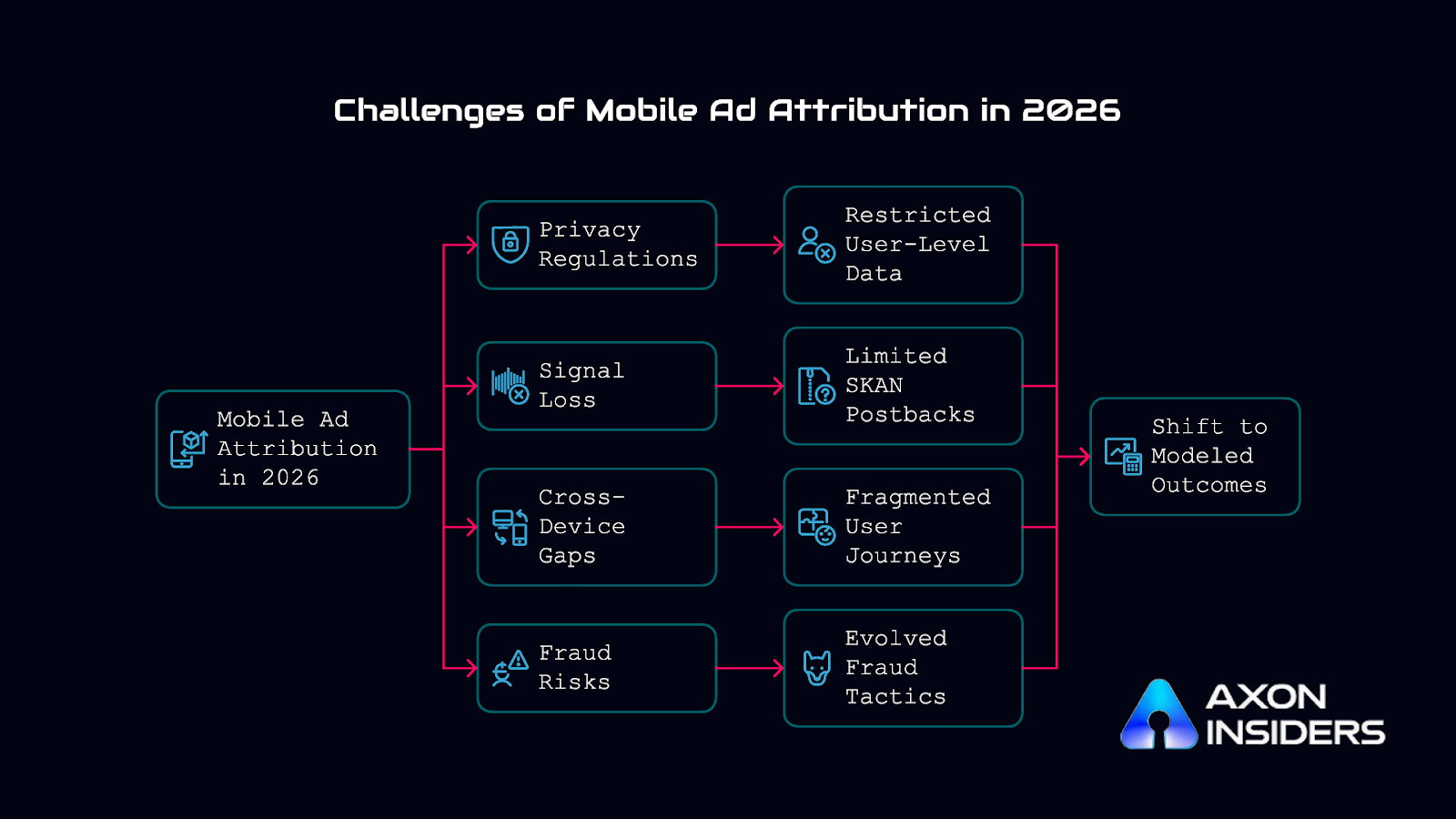
Attribution has always been messy, but in 2026 it’s downright complicated. Advertisers are trying to measure ROI in a world where the signals are weaker, the rules are stricter, and fraudsters are smarter. Four challenges dominate the landscape:
Privacy Regulations
GDPR, CCPA, and Apple’s ATT have rewritten the rules of tracking. User‑level data (once the backbone of deterministic attribution) is now heavily restricted. That means advertisers can’t simply follow a user from click to conversion. Instead, they’re forced to work with aggregated or anonymized data, which makes precision harder and forces a shift toward modeled outcomes.
Signal Loss
SKAN postbacks provide only limited data, often delayed and stripped of granularity. Deterministic attribution, the clean “this click led to this purchase” story, is no longer reliable. Advertisers are left piecing together fragments, relying on statistical models to fill in the blanks.
Cross‑Device Gaps
Consumers don’t live on one device. They bounce from mobile to desktop to connected TV, and attribution systems struggle to stitch those journeys together. A campaign that sparks intent on TikTok might convert later on a desktop browser, but without proper cross‑platform visibility, that influence is invisible in the data.
Fraud Risks
Fraud has evolved. Click injection, fake installs, and misattribution inflate costs and distort ROI. In a privacy‑restricted world, fraud detection is harder because the signals that once flagged suspicious activity are now hidden or unavailable.
How Does SKAN Affect Mobile Attribution?
Apple’s SKAdNetwork (SKAN) has become the defining framework for mobile attribution on iOS, and it has reshaped the way advertisers measure performance:
Conversion Windows
SKAN only reports conversions within limited timeframes. If a user installs an app but purchases weeks later, that data may never be tied back to the campaign. This delay creates blind spots in long‑tail attribution.
Privacy Thresholds
Conversions are only reported when they meet Apple’s minimum privacy thresholds. Small campaigns or niche audiences often fall below those thresholds, meaning conversions simply disappear from the reporting.
Modeled Conversions
Because SKAN data is incomplete, advertisers lean heavily on statistical modeling to estimate performance. Modeled conversions aren’t perfect, but they provide directional insight when deterministic data is missing.
SKAN 4.0 vs Earlier Versions
SKAN 4.0 introduced multiple postbacks and coarse conversion values, offering more granularity than earlier versions. Advertisers can now see limited signals across different time windows, which helps, but it’s still far from the clarity marketers had before ATT.
What Tools Are Used for Mobile Ad Attribution?
Attribution is about building trust in the data you use to make million‑dollar decisions. The tools you choose shape how clearly you see the customer journey.
- Mobile Measurement Partners (MMPs): Platforms like AppsFlyer, Adjust, Singular, Triple Whale, Northbeam, WorkMagic, etc, have become the backbone of attribution. They don’t just assign credit; they help detect fraud, normalize data across networks, and give advertisers a single source of truth. For growth teams, MMPs are the referee in a game where every channel wants to claim the win.
- Analytics Platforms: Tools like Firebase, Mixpanel, and Amplitude dig deeper into what happens after the install. They track retention, funnel drop‑offs, and in‑app events, turning attribution from a “who drove the install” question into a “who drove long‑term value” answer. Without this layer, advertisers risk optimizing for installs that never monetize.
- In‑House Systems: Larger advertisers often build proprietary attribution stacks. Why? Because off‑the‑shelf tools can’t always capture the complexity of cross‑channel journeys or unique KPIs. In‑house systems unify data across search, social, programmatic, and even offline touchpoints, giving brands a custom lens on performance. It’s resource‑intensive, but for companies spending tens of millions, the control is worth it.
How to Improve Mobile Ad Attribution Accuracy
You need to pick the right tool, but you also need discipline in setup, alignment, and ongoing audits. Here's how you can improve attribution:
Proper SDK & Pixel Setup
Attribution fails more often because of sloppy implementation than because of bad models. If SDKs aren’t firing correctly or pixels aren’t placed on the right events, the data is broken before it even hits the dashboard.
Align Goals With KPIs
Attribution should reflect business outcomes, not vanity metrics. If your KPI is subscription renewals, don’t let attribution default to installs. Misalignment here leads to campaigns that look efficient but don’t actually drive revenue.
Modeled Conversions & Incrementality
Signal loss is the reality of 2026. That means advertisers must embrace modeled conversions and incrementality testing. Lift studies (comparing exposed vs. holdout groups) reveal whether spend is truly driving incremental outcomes. It’s not perfect, but it’s the closest thing to truth in a privacy‑restricted world.
Audit Data Quality
Fraud and misattribution creep in quietly. Regular audits, checking for click injection, fake installs, or suspicious traffic patterns, are essential. Attribution accuracy isn’t a “set it and forget it” process; it’s an ongoing battle to keep the data clean.
What’s the Best Way to Manage Mobile Ad Attribution?
Managing mobile ad attribution in 2026 is a technical challenge, but it makes all the difference between scaling with confidence and burning through budgets blindly. Advertisers are under pressure to prove that every dollar spent is driving incremental growth, yet the old playbook of clicks, deterministic tracking, and siloed tools no longer holds up.
Before we look at how Axon reshapes attribution, it’s worth examining why the traditional approaches are breaking down.
How Axon by AppLovin Solves These Challenges
Axon was built for this new reality where attribution must be modeled, privacy‑safe, and incrementality‑driven. It doesn’t just patch over the cracks; it rethinks attribution from the ground up.
- Predictive Bidding Instead of waiting for last‑click reports, Axon reallocates spend in real time based on conversion probability. This means attribution isn’t just about assigning credit after the fact; it actively shapes where budgets go, ensuring dollars chase the impressions most likely to deliver incremental outcomes.
- Creative Rotation Attribution is only as good as the engagement it measures. Fatigued creatives distort data, inflating clicks without driving real intent. Axon automatically suppresses underperforming creatives and prioritizes high‑performers, so attribution reflects genuine engagement rather than vanity metrics.
- SKAN‑Native Attribution Modeling Apple’s SKAN stripped attribution down to limited postbacks. Many tools still struggle to make sense of this restricted data. Axon trains its models directly on SKAN signals, turning those fragments into actionable insights. Campaigns can be optimized even when event data is sparse, keeping attribution viable in Apple’s privacy‑first ecosystem.
- Privacy‑Safe Optimization Deterministic identifiers are gone. Axon embraces aggregated signals, pixel events, device context, and engagement trends to optimize campaigns without violating compliance. Attribution becomes both effective and future‑proof, built to thrive in a world where user‑level tracking is no longer possible.
The Advantage for Performance Advertisers
The difference isn’t theoretical, it shows up in the numbers:
- Lower Wasted Spend: Incrementality tests reveal Axon’s iROAS is ~12% higher than last‑click attribution, proving it captures true incremental value.
- Stronger ROAS: Axon’s CPC averages around $0.70 while CTR hits 5.2%, outperforming traditional setups that inflate costs with weaker engagement.
- Attribution That Reflects Actual Value: Halo effects show 26% of incremental orders happen outside direct‑to‑consumer channels, meaning Axon captures cross‑channel impact that old models miss entirely.
For advertisers, this means attribution is cleaner and actionable. Budgets can be scaled with confidence, knowing spend reflects real growth rather than noise.
Key Takeaways for Advertisers
- Traditional attribution models underreport impact and inflate costs.
- Privacy and signal loss demand a shift toward modeled conversions and incrementality testing.
- Axon stands out by combining predictive bidding, creative rotation, SKAN‑native attribution, and privacy‑safe optimization.
- The result is attribution that reflects real incremental growth, not vanity metrics.
👉 Join Axon Insiders to access exclusive attribution benchmarks, case studies, and optimization playbooks designed for 2026’s privacy‑first landscape.

See real in-app advertising examples from ecommerce brands running ads inside mobile games on Axon by AppLovin.

Mobile game advertising reaches over 1 billion daily users with full-screen, unskippable ads. Here is why ecommerce brands are finding new customers on Axon by AppLovin and how to set up for real results.
.png)