

What Is Axon by AppLovin? AI Ad Platform for ROAS Optimization
What Is Axon by AppLovin?
The Mobile Advertising Platform Built for performance, Not Guesswork
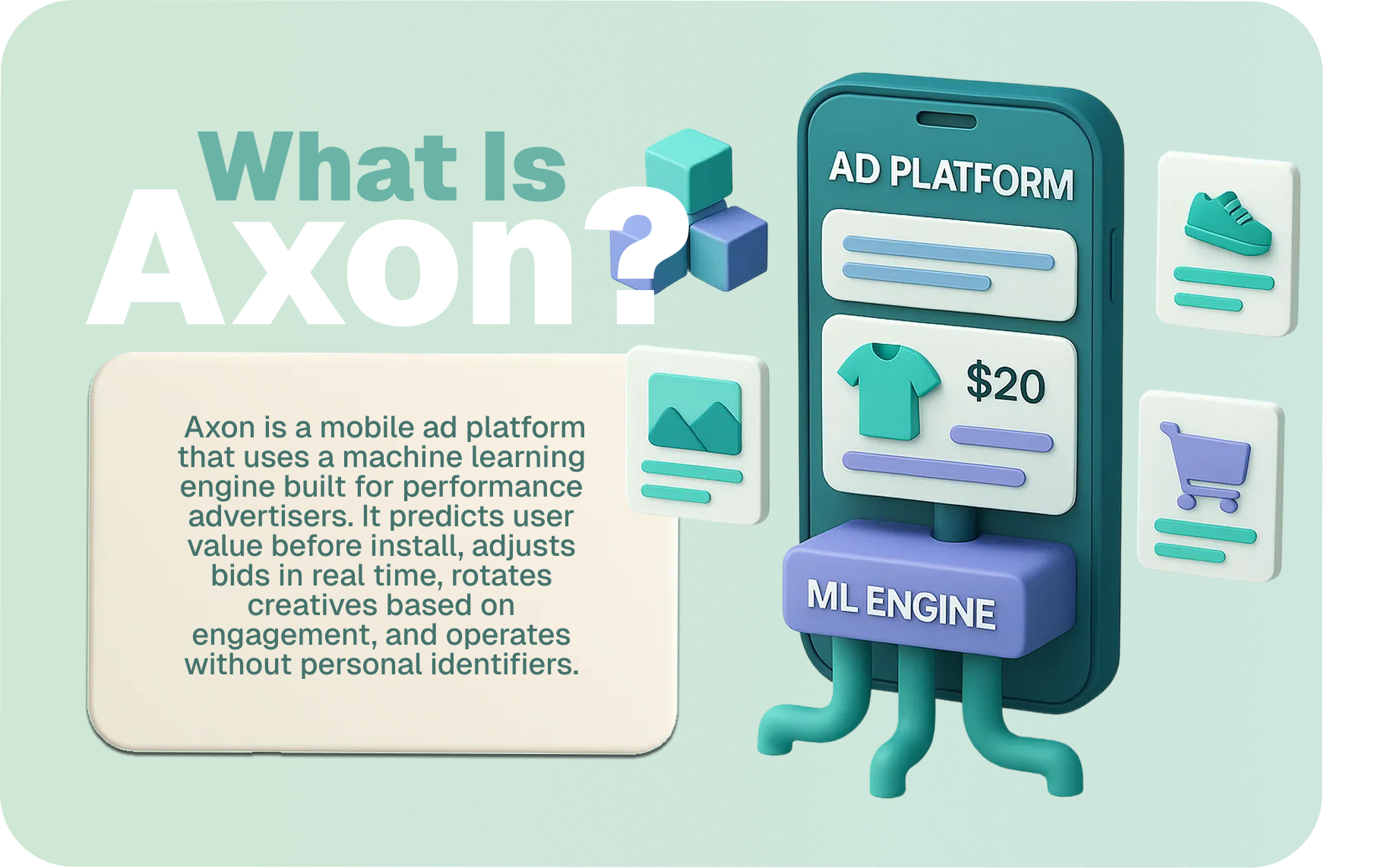
Axon by AppLovin is an AI-powered advertising platform designed to optimize performance through predictive bidding, real-time creative rotation, and privacy-safe targeting. Built for mobile-first brands, Axon adapts to user behavior and delivers performance across gaming, ecommerce, and fintech apps.
Axon unlocks mobile advertising for ecommerce and retail brands across any number of industries — a space where traditional mobile ad platforms have struggled to drive conversions. It does this through predictive behavior modeling, dynamic creative formats like product ads, and automation that adapts in real time.
Why Axon Matters for Performance Marketers
Most ad platforms promise smarter targeting and better ROAS. But for advertisers managing real budgets and real outcomes, automation alone isn’t enough. Rebranded in October 2025, Axon introduces a new approach to mobile campaign optimization focused on predictive bidding and real-time creative performance.
Axon uses machine learning to optimize delivery based on actual conversion signals. It ingests pixel data, adjusts bids dynamically, and rotates creatives based on performance — all without manual toggling. This helps advertisers reduce both conversion based metrics like CPP (Cost-Per-Purchase) while driving higher Return on Ad Spend (ROAS) and Lifetime Value (LTV) and scaling efficiently across mobile environments.
How Ecommerce Advertisers Use Axon
Axon is a demand-side platform built for performance. For ecommerce and DTC brands, it automates bidding, creative rotation, and campaign delivery using real-time conversion signals from your website.
Unlike social ad tools or mediation platforms, Axon doesn’t rely on modeled conversions or manual targeting. It ingests pixel-based data, models user behavior, and prioritizes delivery toward high-value impressions.
This enables:
- Smarter spend allocation
- Faster creative iteration
- Stronger ROAS and CPP performance
- Resilience to privacy constraints and signal loss
Whether you’re launching a product or scaling a seasonal campaign, Axon gives you the infrastructure to grow without micromanaging every bid or audience.
How to Set Up a Web Campaign in Axon
1. Define Your Optimization Goal
Axon supports two primary goals for web campaigns:
- ROAS (Return on Ad Spend): Ideal for revenue-driven campaigns
- CPP (Cost Per Purchase): Useful for controlling acquisition costs
Each campaign should be configured around a single goal. Axon’s engine will automatically adjust bidding and delivery to maximize performance against that target.
This ensures that every impression is evaluated based on its likelihood to drive the outcome you care about — not just engagement or clicks.
2. Install the Axon Pixel
To enable optimization, Axon needs conversion signals. These are collected via:
- Axon Pixel: Tracks key events like purchases, add-to-cart actions, and page views
- Conversions API: Passes server-side events for improved reliability and attribution accuracy
These signals are anonymized and aggregated, then fed into Axon’s machine learning engine to model conversion likelihood and user value. This allows Axon to:
- Bid more aggressively on high-value impressions
- Conserve spend on low-intent traffic
- Adapt in real time to changes in user behavior
For ecommerce brands, this setup ensures campaigns are optimized based on actual purchase behavior — not assumptions or demographic proxies.
3. Upload Creative Variants
Axon’s creative intelligence system rotates ad variants based on real-time performance. To support this, upload a diverse set of assets and refresh them regularly.
Recommended formats:
- Static images with bold headlines and clear CTAs
- Short-form videos (30–60 seconds) featuring product demos or testimonials with strong hooks in the first 5 seconds
- Interactive overlays or end cards like tap-to-shop elements or carousel previews
Best practices:
- Upload at least 3–5 variants per campaign
- Refresh creatives every 1–2 weeks
- Align messaging with funnel stage — awareness, consideration, or conversion
Axon automatically suppresses underperforming creatives and shifts budget toward top performers.
4. Monitor Performance and Export Data
Axon’s reporting suite provides visibility into campaign performance across geo, device, creative, and contextual segments.
You can track:
- ROAS and CPP by region, device type, and creative variant
- Engagement metrics like CTR, conversion rate, and time-to-purchase
- Creative performance across formats and styles
For deeper analysis, export data using:
- Axon Reporting API
- Connectors like Portable.io or Supermetrics
- BI tools such as Looker Studio, BigQuery, Snowflake, or Google Sheets
This allows you to build custom dashboards, compare Axon performance against other platforms, and align campaign outcomes with broader business KPIs.
What Makes Axon Different from Other Ad Platforms
Axon is a demand-side platform designed to optimize campaigns based on conversion outcomes rather than surface-level metrics like impressions.
Predictive Bidding Based on Real Conversion Signals
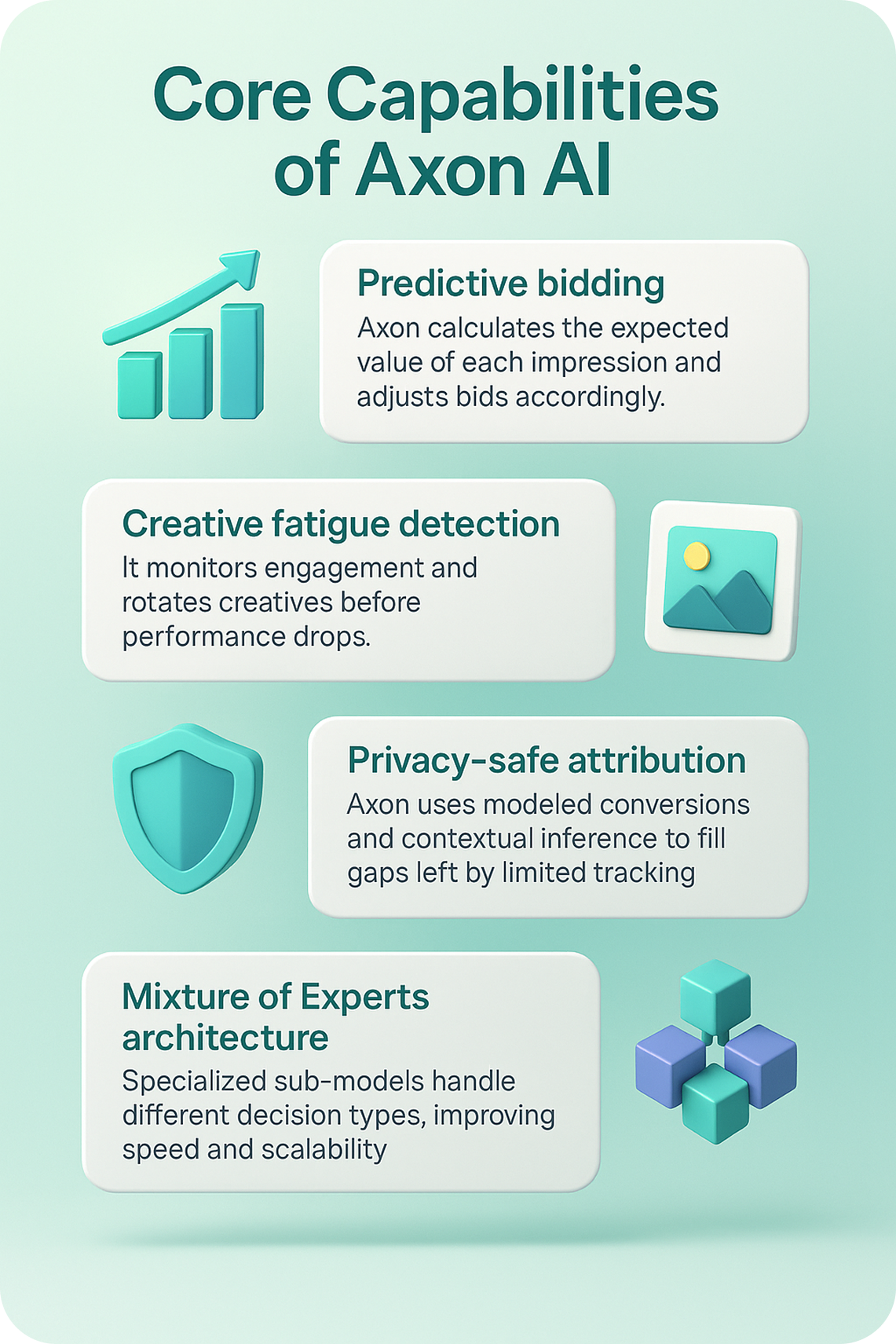
Axon uses machine learning to predict which impressions are most likely to convert. It analyzes pixel-based data and contextual signals (like device type, time of day, and session depth) to:
- Bid more aggressively on high-value users
- Conserve spend on low-intent traffic
- Adapt in real time to changes in user behavior
Unlike platforms that rely on static rules or historical averages, Axon recalibrates instantly. If user behavior shifts — say, during a seasonal sale — Axon adjusts automatically to follow performance.
Real-Time Creative Rotation
If a creative starts to fatigue, Axon shifts delivery to higher-performing variants instantly. This helps you:
- Maintain engagement without manual testing
- Scale creative testing across geos and audiences
- Improve conversion rates with less overhead
Whether you’re launching a new product or scaling across regions, Axon ensures your best-performing creatives get the most visibility.
Privacy-First Attribution
Axon is built for a privacy-first world. For web campaigns, it uses:
- Pixel-based tracking to capture conversion events
- Conversions API for server-side reliability
- Aggregated, anonymized signals — not personal identifiers
This setup complies with GDPR, CCPA, and other global privacy standards. It also ensures your campaigns remain resilient to signal loss and browser-level restrictions.
Note: SKAN attribution is only relevant for mobile app campaigns. Web campaigns on Axon do not use SKAN postbacks.
Why Leading Brands Go Live on Axon
Global Scale You Can Trust
Axon isn’t just another ad platform, it’s built on AppLovin’s massive ecosystem:
- +1 Billion Daily Active Users reached across mobile-first environments
- $11 Billion in annual advertiser spend flowing through the platform
- Backed by a multi‑billion dollar market cap company with proven performance infrastructure
This scale means your campaigns scale efficiently across ecommerce, gaming, fintech, and retail audiences worldwide.
Ads That Feel Native to the User Experience
Axon’s creative intelligence ensures ads appear seamlessly within the environments your customers already love:
- Dynamic product ads that showcase your catalog in real time
- Short-form video units with strong hooks in the first 5 seconds
- Interactive overlays like tap‑to‑shop carousels that drive engagement without friction
The result: ads that feel less like interruptions and more like personalized shopping experiences.
Proof From Brands You Know
Don’t just take our word for it — leading ecommerce and DTC brands are already scaling with Axon:
- MAËLYS – scaled to $200K/day in profitable Axon spend within just one week
- HexClad – drove $1M+ in incremental revenue in only 3 weeks
- Portland Leather – boosted purchases by 130,000+ in a single campaign cycle
These aren’t isolated wins — they’re proof that Axon’s predictive bidding and creative intelligence deliver measurable outcomes for brands across industries.
Explore more success stories in our case studies library.
Prospecting Campaigns: Find Your Next Customer
Axon now supports prospecting campaigns designed to help brands reach net‑new audiences.
- Predictive bidding identifies high‑intent users before they convert
- Privacy‑safe signals (page views, add‑to‑cart actions, session depth) guide delivery
- Automated creative rotation ensures your best assets reach the right prospects
The Bottom Line
With unmatched scale, seamless user experiences, proven brand success, and prospecting capabilities, Axon is the performance platform built to grow ecommerce and DTC brands in a privacy‑first world.
Who Should Use Axon
Axon is designed for marketers who need to drive measurable outcomes — not just manage impressions or clicks. It’s especially effective for teams that rely on purchase behavior to guide spend and scale efficiently.
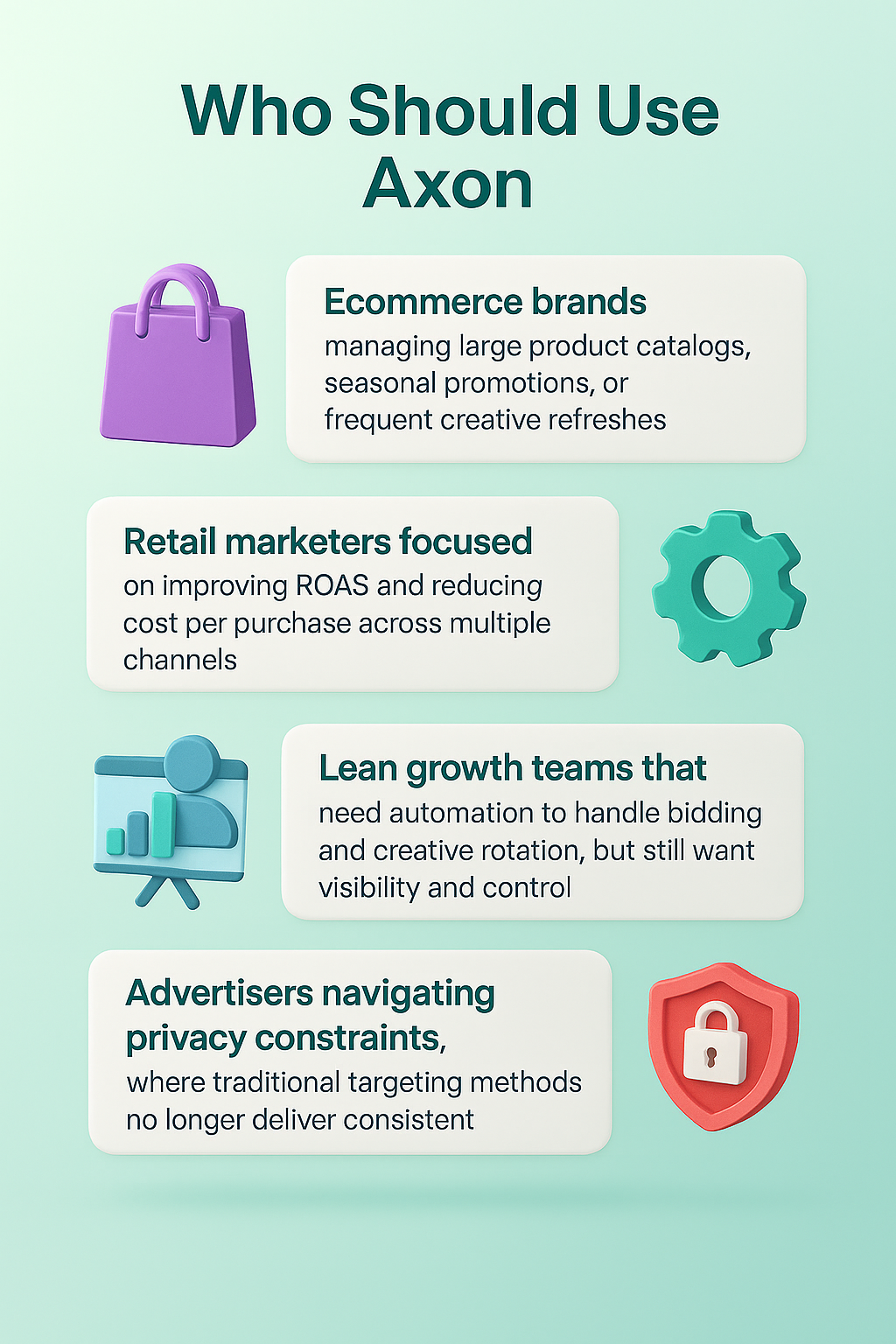
It’s a strong fit for:
- Ecommerce brands managing large product catalogs, seasonal promotions, or frequent creative refreshes
- Retail marketers focused on improving ROAS and reducing cost per purchase across multiple channels
- Lean growth teams that need automation to handle bidding and creative rotation, but still want visibility and control
- Advertisers navigating privacy constraints, where traditional targeting methods no longer deliver consistent results
By combining predictive bidding with real-time creative optimization, Axon helps these teams allocate budget where it’s most likely to convert — even in environments with limited signal or shifting user behavior.
Final Thoughts: Axon Is Built for Performance
Axon by AppLovin is a full-funnel advertising platform that helps ecommerce and DTC brands scale efficiently. It automates the core levers of performance — bidding, creative rotation, and delivery — while giving marketers control over campaign goals, inputs, and reporting.
For teams looking to move beyond manual adjustments and opaque optimization models, Axon offers:
- Predictive bidding based on real-time conversion signals
- Automated creative testing and fatigue management
- Privacy-compliant attribution using pixel and server-side data
- Flexible reporting integrations with your existing analytics stack
Explore Axon at axon.ai
FAQs:
Is Axon only for mobile apps?
No. Axon supports both mobile app and web campaigns. For ecommerce and DTC brands, Axon uses pixel-based tracking and server-side signals to optimize delivery toward purchase behavior — without requiring an app install. Web advertisers can fully leverage Axon’s predictive bidding and creative rotation using their website data alone.
What goals can I optimize for?
Web campaigns in Axon support two primary goals:
- ROAS (Return on Ad Spend): Axon prioritizes impressions likely to generate higher revenue per dollar spent.
- CPP (Cost Per Purchase): Axon minimizes acquisition cost while maintaining conversion quality.
Each campaign should be built around one goal. Axon’s machine learning engine uses that objective to guide bidding and delivery decisions in real time.
Does Axon support retargeting?
Not in the traditional sense. Axon does not support uploading user lists or segmenting audiences for retargeting. Instead, it uses contextual and behavioral signals — such as page views, add-to-cart actions, and session depth — to identify high-intent users and serve relevant creatives. This approach maintains privacy compliance while still driving conversion efficiency.
How does Axon handle creative testing?
Axon automates creative rotation based on performance signals. You don’t need to manually A/B test — the system continuously evaluates CTR, conversion rate, and engagement metrics to suppress underperforming creatives and scale top performers. To support this, advertisers should:
- Upload 3–5 creative variants per campaign
- Refresh assets every 1–2 weeks
- Align messaging with funnel stage (awareness, consideration, conversion)
Is Axon compliant with privacy regulations?
Yes. Axon is built for a privacy-first environment. It uses aggregated, anonymized signals and complies with GDPR, CCPA, and other global standards. For web campaigns, it relies on pixel-based tracking and server-side events via the Conversions API — without collecting personal identifiers or relying on third-party cookies.
Can I export performance data?
Absolutely. Axon supports data exports via its Reporting API and integrations with tools like Portable.io, Supermetrics, Looker Studio, BigQuery, and Google Sheets. This allows advertisers to:
- Build custom dashboards
- Compare Axon performance against other platforms
- Align campaign metrics with broader business KPIs
- Run cohort analysis or creative diagnostics across time and audience segments

See real in-app advertising examples from ecommerce brands running ads inside mobile games on Axon by AppLovin.

Mobile game advertising reaches over 1 billion daily users with full-screen, unskippable ads. Here is why ecommerce brands are finding new customers on Axon by AppLovin and how to set up for real results.
.png)