
How to Make UGC Video Ads for Axon by AppLovin
How to Make UGC Video Ads for Axon: Length, Hooks, Captions, and What Actually Converts
If you have been running UGC ads on Meta for a while, you probably already know the basics. Short video, strong hook, real person, clear CTA. That formula works. The question most brands are asking right now is whether the same approach works on Axon, and the honest answer is: kind of, but not exactly.
Before getting into creative strategy, it helps to understand exactly what an Axon ad is made of. There are three components working together as a single unit
The first is the full-screen portrait video - unskippable, up to 60 seconds, and the part of the experience this guide focuses on most.
The second is the Axon Interactive Page, or AIP. This is the interactive end card that appears immediately after the video finishes. You can build it using Axon's Creative Studio or upload a portrait image directly. This is where your CTA lives and where the user decides whether to tap through to your site. The video and the AIP need to work together - whatever offer or message you close the video with should be reflected immediately on the AIP. Inconsistency between the two is one of the most common conversion killers on this format.
The third is the dynamic product catalog. If you have your catalog synced in Axon's Catalogs Manager, Axon can serve personalized product recommendations tailored to each individual user based on their behavior and the products in your feed. This is what makes the ad feel relevant rather than generic, and Axon's data suggests it can drive up to a 20% lift in conversions when implemented correctly.
All three components are worth getting right. Most brands focus almost entirely on the video, which matters, but leaving the AIP or catalog setup as an afterthought means you are not getting the full value of the format.
The user is not scrolling. They are mid-session in a mobile game, and your ad has their attention in a way that no social feed can replicate. That changes what good UGC looks like. The hook still matters, but the middle of the video matters just as much. The length that would feel too long on TikTok is often exactly right on Axon. And certain things that do not seem important on other platforms, captions especially, are non-negotiable here.
This guide breaks down exactly how to build UGC video ads for Axon: what length to target, how to structure your hook, why captions matter more than you think, and the specific creative patterns the Axon team says are driving the strongest results right now.
Why UGC Works So Well on Axon Specifically
UGC outperforms polished brand creative on most channels, but the reason it works on Axon is a little different from why it works on Meta or TikTok.
On social platforms, the feed is full of content from people the user actually follows. A polished ad stands out as an ad immediately, and the viewer scrolls. UGC blends in visually, which buys a few extra seconds of attention before the viewer decides to engage or leave.
On Axon, the dynamic is different. The ad is already full screen and unskippable. The viewer is not going to scroll away. So the reason UGC works here is not camouflage, it is credibility. A real person talking to the camera about a product they genuinely use is more convincing than a branded video when the viewer has no choice but to watch. Authenticity holds attention in a way that produced content often does not.
Axon's own data backs this up. The vast majority of top-performing videos on the platform use a UGC-style format, either a single person's testimonial or multiple people sharing positive experiences. It is not a coincidence.
How Long Should Your UGC Video Be?
This is where most brands get it wrong when they first start running on Axon. The instinct from Meta and TikTok is to keep everything short, under 30 seconds, often under 15. On Axon, that instinct works against you.
Axon analyzed the top 5% of videos on its platform and found that the median length was 37 seconds. The recommendation from the team is to test videos of all lengths, with a specific focus on anything longer than 30 seconds. The sweet spot for UGC tends to sit between 35 and 50 seconds.
The reason is simple. Axon gives you guaranteed attention for the duration of the ad. A 15-second video is leaving most of that window unused. You have time to build a real story, get through the benefit, address a concern, and deliver a strong close before the end card appears. Brands that treat Axon like TikTok and upload 10-second clips are not taking advantage of the one thing that makes the format genuinely different.
That said, longer does not mean padded. A 45-second video that earns every second performs well. A 45-second video with 20 seconds of filler does not. The goal is to use the full window purposefully, not just to hit a number.
How to Structure the Hook for Axon
The hook still matters on Axon even though the ad is unskippable. The viewer cannot leave in the first 5 seconds, but that does not mean you have a captive audience for the full video. If the opening is boring, attention drifts. The hook's job is to give the viewer a reason to actually watch rather than just wait for the ad to end.
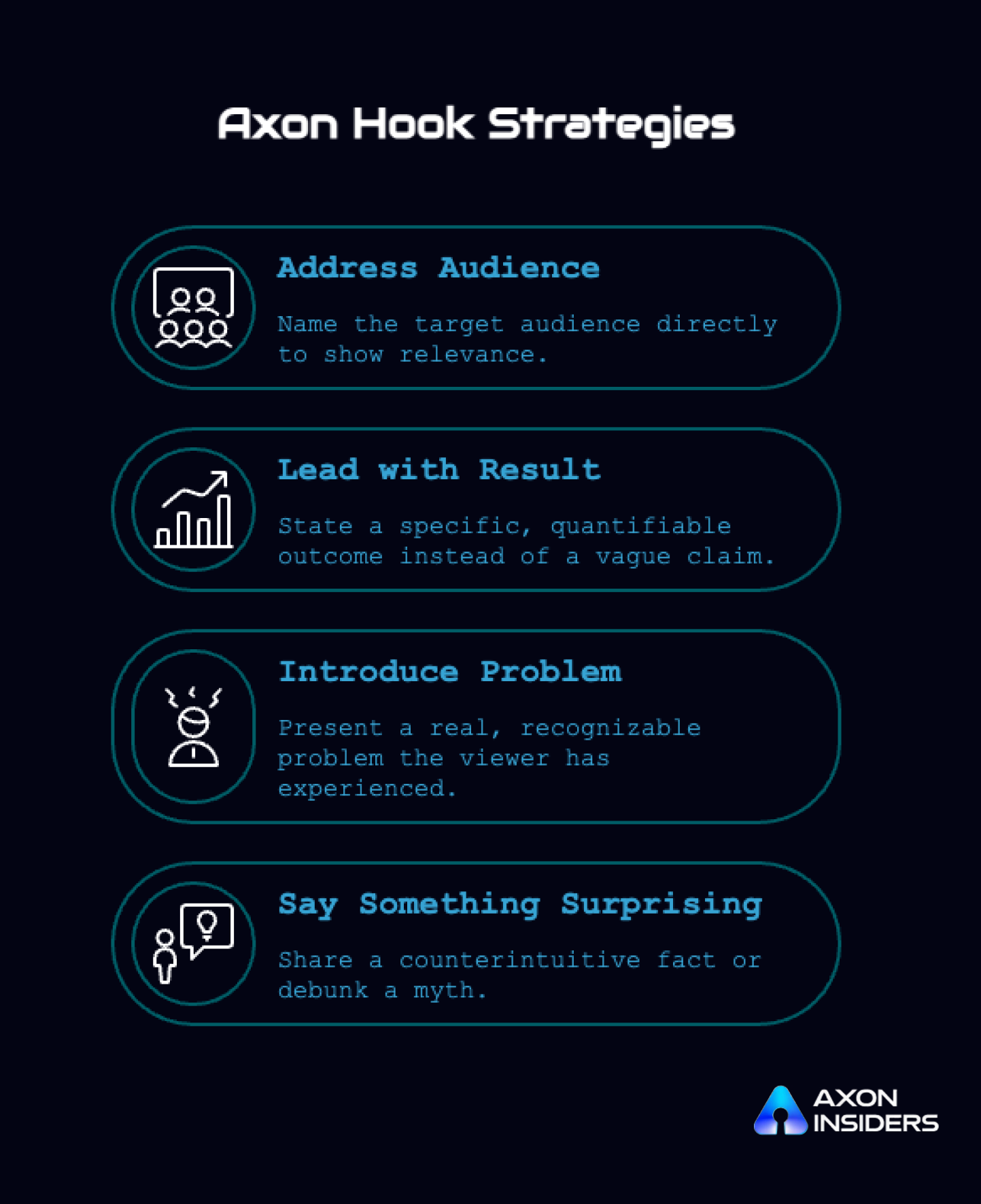
The Axon team has found that the strongest hooks do one of a few things:
- Address a specific audience directly. About 30% of top ads on Axon open by naming who the video is for. "As a busy new mom" or "If you are over 40 and still struggling with energy" immediately tells a subset of the audience that this is relevant to them. It filters in the right viewers rather than trying to appeal to everyone.
- Lead with a specific result, not a general claim. "I lost 12 pounds in 6 weeks" is a hook. "This product changed my life" is not. Specificity is what earns attention in the first few seconds.
- Introduce a problem the viewer recognizes. Not a manufactured problem, a real one. The more accurately you name something the viewer has actually experienced, the more likely they are to keep watching to hear the answer.
- Say something surprising. A counterintuitive fact or a myth being debunked gives the viewer a reason to pay attention that has nothing to do with whether they were already interested in the product.
One thing to avoid: hooks that were built for social platforms where stopping the scroll is the entire game. Content where the first 3 seconds are deliberately disconnected from the product because the goal was thumb-stop time tends to underperform on Axon. Since the ad is already unskippable for 5 seconds, you do not need a trick. You need a reason to watch.
Captions Are Not Optional
A large portion of people playing mobile games do so with their sound off. In a waiting room, on public transport, next to a sleeping partner. If your UGC video relies on audio to communicate its value proposition, you are losing a significant chunk of potential conversions before the hook even lands.
Captions are one of the clearest performance signals in Axon's creative data. Videos with subtitles substantially outperform those without. It is not a small difference. It is the kind of difference that shows up immediately when you compare two otherwise identical videos.
A few things worth knowing about how to do captions well on Axon:
- Keep them large enough to read without zooming in. Mobile screens are small. Tiny caption text defeats the purpose.
- High contrast is essential. White text with a dark outline or dark background strip reads in any lighting condition. Colored captions on busy video backgrounds often do not.
- Match the pacing of the speech. Captions that lag behind or run ahead of the audio create a disconnect that pulls the viewer out of the experience.
- Do not just caption the words. Emphasize the key phrases. Some of the best-performing UGC ads on Axon use a larger font size or a different color for the most important lines in the script.
What the Middle of the Video Should Actually Do
Most UGC briefs focus on the hook and the CTA and leave the middle of the video vague. On Meta, that is understandable because many viewers never make it that far. On Axon, the middle is where the conversion happens. If someone is still watching at the 15-second mark, they are genuinely interested. What you do with the next 20 to 30 seconds determines whether they tap through.
The middle of a strong UGC video on Axon should do one of the following:
- Build credibility through specificity. Not "it worked really well" but "I noticed the difference in my energy levels by day 10 and I have not missed a day since." The more specific the detail, the more believable the claim.
- Address the obvious objection. Whatever hesitation a skeptical viewer would have about this product, the middle of the video is the right place to handle it. If the price is high, address it. If the category is crowded, explain what makes this one different. Getting ahead of the objection is more effective than ignoring it.
- Include social proof naturally. Axon's data shows that 24% of top-performing videos include some form of social validation in the middle section. References to review counts, mentions that the product went viral, or quotes from other customers all work. It does not have to feel forced. The creator can simply say "I was not expecting much based on the reviews but then I saw 50,000 people had bought it and figured I would try."
How to Close the Video and Hand Off to the End Card
The last 5 to 10 seconds of the video are where you make the ask. On Axon, this is immediately followed by the interactive end card, so the close and the end card need to work together as a single unit, not as two separate things.
The video close should state the offer clearly and specifically. Not "go check it out" but "go get 20% off your first order, the link is right below." If there is a promotion running, name it in the video. Whatever the end card says, the video should say first. Inconsistency between what the creator promises and what the end card shows is one of the most common conversion killers on this format.
The end card itself should be clean, match the energy of the video, and have a single clear CTA. One button. One action. The more choices you give someone on the end card, the fewer conversions you get.
The UGC Formats That Are Converting Right Now
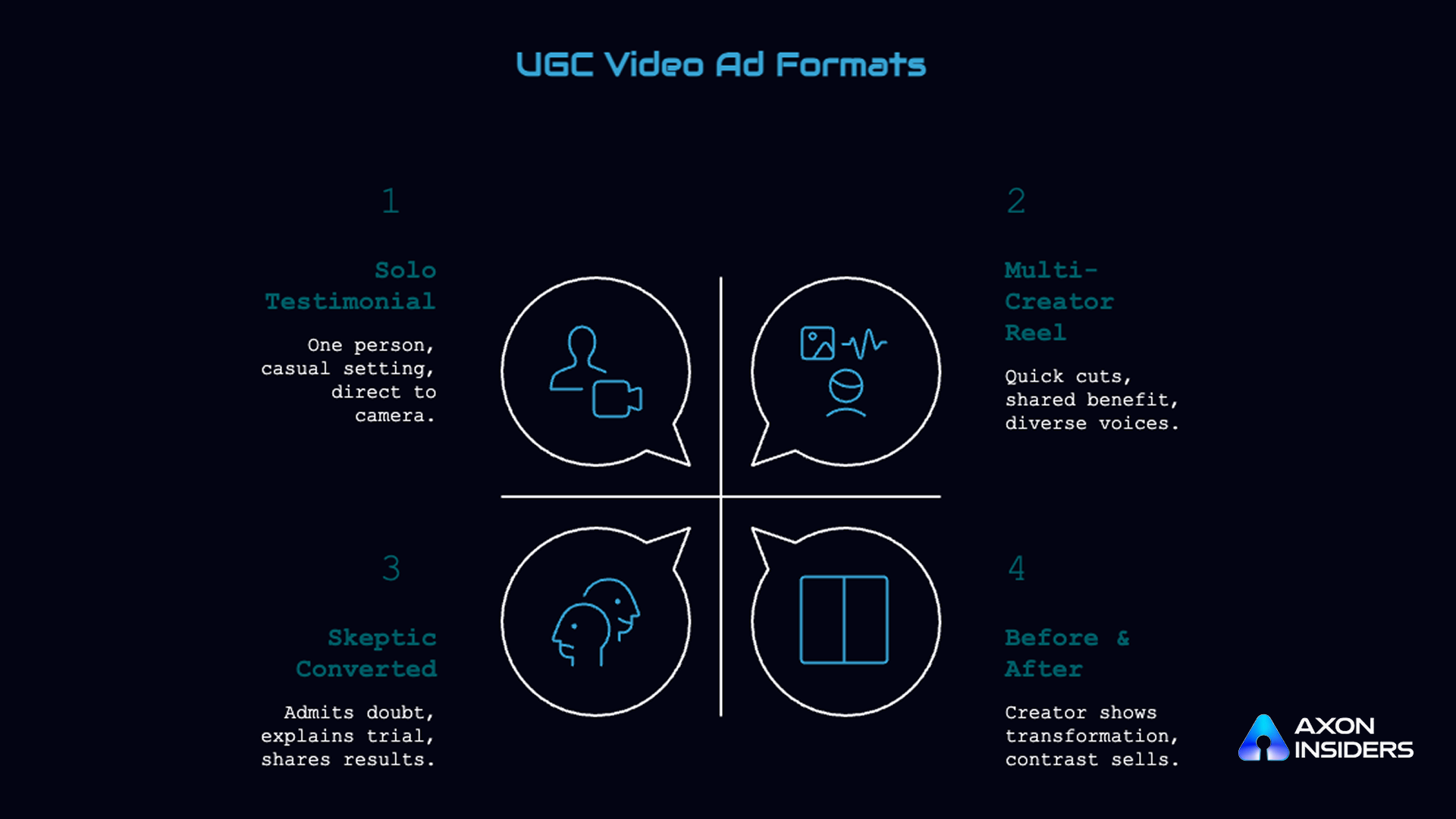
Based on what the Axon team has shared and what the Axon Insiders community is seeing in practice, these are the UGC structures that are performing consistently:
The single creator testimonial
One person, casual setting, speaking directly to camera. Opens with a specific result, builds through the middle with personal detail, closes with the offer. 35 to 50 seconds. This is the format that works across the widest range of categories.
The multi-creator reel
Multiple people, quick cuts between each one, all speaking to the same benefit from their own perspective. Works especially well for products with a broad audience because different voices resonate with different segments. Axon's algorithm will figure out which creative is driving conversions among which users.
The before and after walkthrough
Creator describes life before the product, then after. The contrast does the selling. Works particularly well for health, beauty, fitness, and any category where there is a visible or felt transformation. The middle section is where the transformation is explained in specific terms.
The skeptic converted
Creator opens by admitting they did not believe the product would work. They explain their skepticism, what made them try it anyway, and what happened when they did. This format works because it mirrors the internal monologue of a skeptical viewer and walks them through the same journey in 40 seconds.
What Does Not Work (And Why)
A few patterns that consistently underperform on Axon, even when they work elsewhere:
- Hooks that are unrelated to the product. On social, a random hook that stops the scroll is sometimes worth it, even if it has nothing to do with what you are selling. On Axon, the viewer has 5 seconds before they can skip. A misleading hook that wastes those 5 seconds tends to produce lower downstream conversion even if the rest of the video is strong.
- Videos under 20 seconds. Not because short video is bad, but because on Axon you have a guaranteed attention window that short videos do not use. You are leaving time on the table.
- No captions. Already covered above, but worth repeating. There is no excuse to skip captions in 2026. Tools like CapCut and Descript add them in minutes.
- Overly produced, scripted delivery. UGC works because it feels real. If the creator is clearly reading from a teleprompter or delivering a corporate script, the credibility that makes UGC effective disappears. Give creators a framework, not a word-for-word script.
How Many UGC Videos Do You Actually Need?
More than you think. The Axon team recommends starting with at least 10 video assets, and UGC should make up the core of that library for most ecommerce brands. This is not about throwing things at the wall. It is about giving Axon's algorithm enough variation to identify which creator, which angle, and which structure is resonating with which segment of the audience.
In practice, that means testing multiple creators, multiple hooks, and multiple benefit angles at the same time. One creator with one script is a starting point, not a creative strategy. Axon will automatically shift spend toward what is converting, but it needs enough variation to learn from.
Regularly adding new creative assets to your library is essential. Axon's model automatically reduces spend on underperforming creatives over time, but it needs fresh material to continue finding the best combinations. Rather than pausing or replacing existing creative, add new videos alongside what's already running - the algorithm will naturally shift spend toward whatever is converting best. The same video seen repeatedly by the same user loses effectiveness fast. New creative keeps the signal quality high and gives the algorithm fresh material to optimize against.
Want to Go Deeper?
Join Axon Insiders to get exclusive access to the benchmarks, creative frameworks, and scaling playbooks that the top ecommerce brands on Axon are actually using. New guides, case studies, and platform updates drop regularly, and the Slack community is where the real conversations happen.
FAQs
How long should a UGC video ad be on Axon?
The sweet spot is 35 to 50 seconds. Axon's data shows the median length of top-performing videos on the platform is 37 seconds. Short clips under 20 seconds tend to underperform because they do not use the guaranteed attention window that makes the format valuable in the first place. Longer videos can work too, up to 60 seconds, as long as every part of the video earns its place.
Do captions really make that big a difference on Axon?
Yes. A large share of mobile gaming happens with sound off, and Axon's creative data consistently shows that videos with captions substantially outperform those without. It is one of the few levers where the performance difference is immediate and measurable. If you are uploading UGC without captions, you are likely leaving a significant amount of conversions behind.
Can I repurpose my best Meta UGC ads directly to Axon?
You can use them as a starting point, and the Axon team actually suggests that Meta creative tends to transfer better than TikTok creative on average. But direct repurposing rarely gets the best results. The format differences matter. Meta UGC is built to stop a scroll in one or two seconds. Axon UGC can build over 35 to 50 seconds because the viewer is not going anywhere. Adjusting the pacing, lengthening the middle section, and making sure captions are on before uploading will all improve performance compared to a straight copy-paste.
Learn how to make UGC video ads that actually convert on Axon by AppLovin. Covers ideal length, hook structure, caption strategy, and the creative patterns driving real ROAS in 2026.

Discover how mobile incrementality testing in 2026 proves true ad impact. Learn from Axon case studies showing higher iROAS, stronger LTV, and halo effects across channels.