

7 Effective Mobile Marketing Strategies for 2026
In 2025, Google, Meta, and increasingly important entrants like OpenAI completely reshaped how marketers have to think about distribution, relevance, timing, and trust. In 2026, the pace of change probably will not slow down, but we are on more solid footing now and we can share a few ways to help marketers navigate a changing landscape.
In this guide, we will explore seven proven strategies for marketers, especially if you are an ecommerce or DTC marketer, to plan and optimize for real-world performance in this new AI-powered world. We will also look at newer tools and platforms, such as Axon by AppLovin, that are shifting the performance marketing landscape.
What You Will Learn
- Start with mobile web, not an app you do not have
- Mobile advertising is being unlocked again (Axon’s lane)
- Treat mobile SEO as the default surface
- Use messaging where intent is high (SMS, WhatsApp)
- Make video native to mobile, not repurposed
- Use context and location without getting creepy
- Build a measurement stack that assumes imperfect data
1. Start With Mobile Web, Not an App You Do Not Have
Most ecommerce and DTC brands do not run mobile apps. They run mobile-optimized sites. That is the primary environment where people discover, compare, and buy. So mobile marketing should start with making the mobile web experience fast, trackable, and conversion oriented.
That means clean mobile UX (scrollable product pages, large tap targets, no intrusive popups), instrumented events (view content, add to cart, purchase), and a way to send those events into your ad platform. If you are using Axon, that is the Axon pixel and Conversions API so its model can optimize toward purchases instead of clicks.
Key things to do:
- Make sure mobile product pages load quickly and show price, image, and call to action above the fold
- Track purchase, add to cart, and product view events
- Send those events to your ad platform so it can optimize on real behavior
2. Mobile Advertising Is Being Unlocked Again
After ATT and SKAN, many teams assumed mobile user acquisition was permanently worse. What actually happened is that app-centric platforms had to rebuild around aggregated, delayed, and sometimes incomplete data. Axon is one of the platforms that was built with that reality in mind.
SKAN dData is delayed, conversion values are limited, and privacy thresholds can block events entirely. Axon compensates by using contextual and behavioral signals such as device, session depth, in-app behavior for apps, and pixel events for web. It uses its Mixture of Experts architecture to bid and rotate creatives in real time. The practical takeaway is that mobile ads are still viable in 2026, but the stack that wins is the one that can optimize on partial data. That is where Axon belongs in an ecommerce or DTC setup.
What this means in practice:
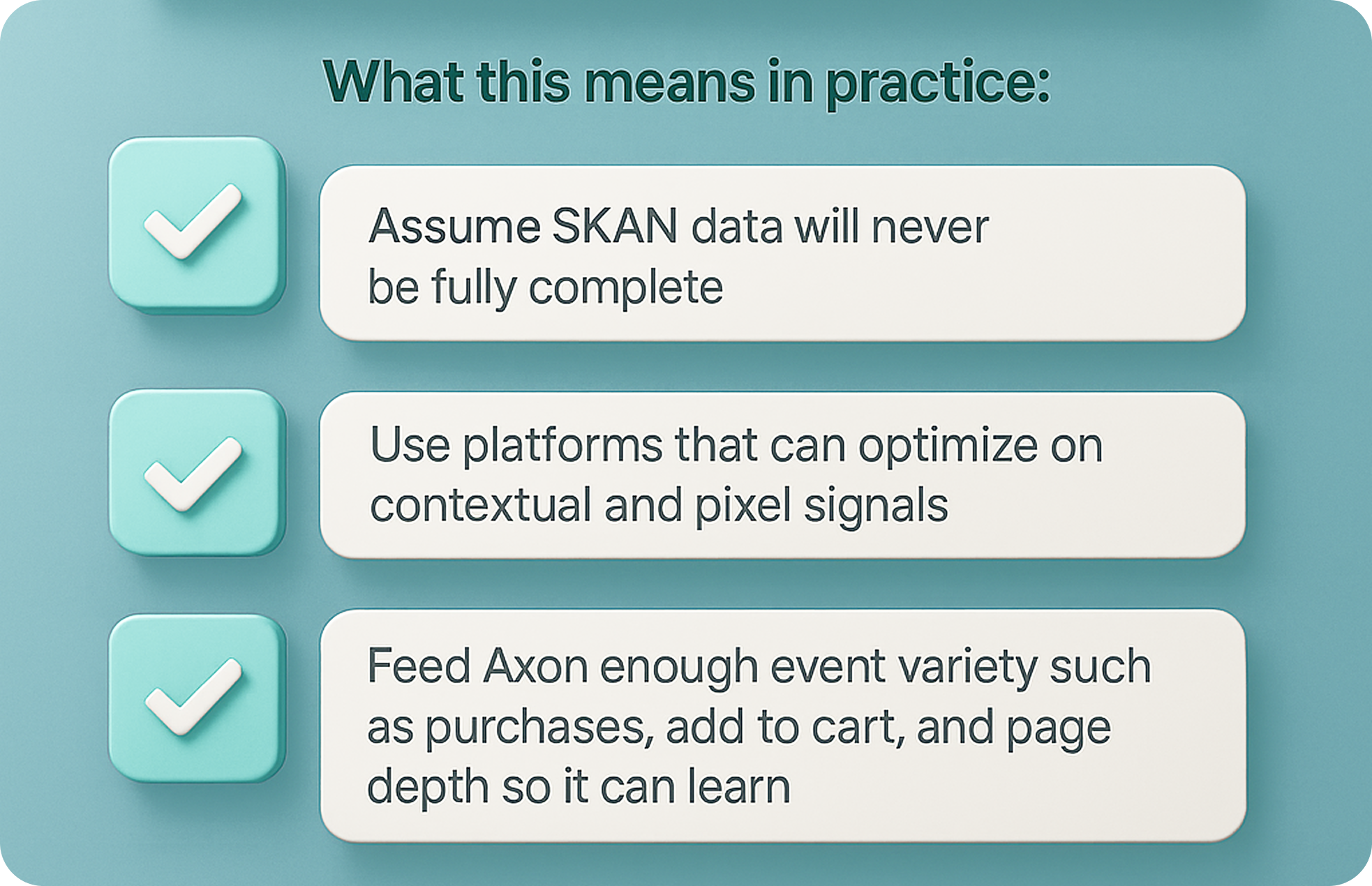
- Assume SKAN data will never be fully complete
- Use platforms that can optimize on contextual and pixel signals
Feed Axon enough event variety such as purchases, add to cart, and page depth so it can learn
3. Treat Mobile SEO as the Default Surface
Google still crawls and ranks the mobile version first, so your mobile site has to load quickly, render cleanly, and answer intent directly. This is more than making it responsive. It is making sure product pages show the essentials above the fold, Core Web Vitals are in range on mobile, and commercial pages match the queries people actually type on phones.
What has changed in 2026 is distribution. Google is surfacing more YouTube and Reddit content on the results page, especially for product research, “is this worth it,” and how to queries. LLM style responses are starting to pull the same kinds of sources because they look like real user discussions and step by step explanations. That means your mobile SEO strategy cannot only be pages on your domain. You also need supporting content on platforms that Google and AI models like to show.
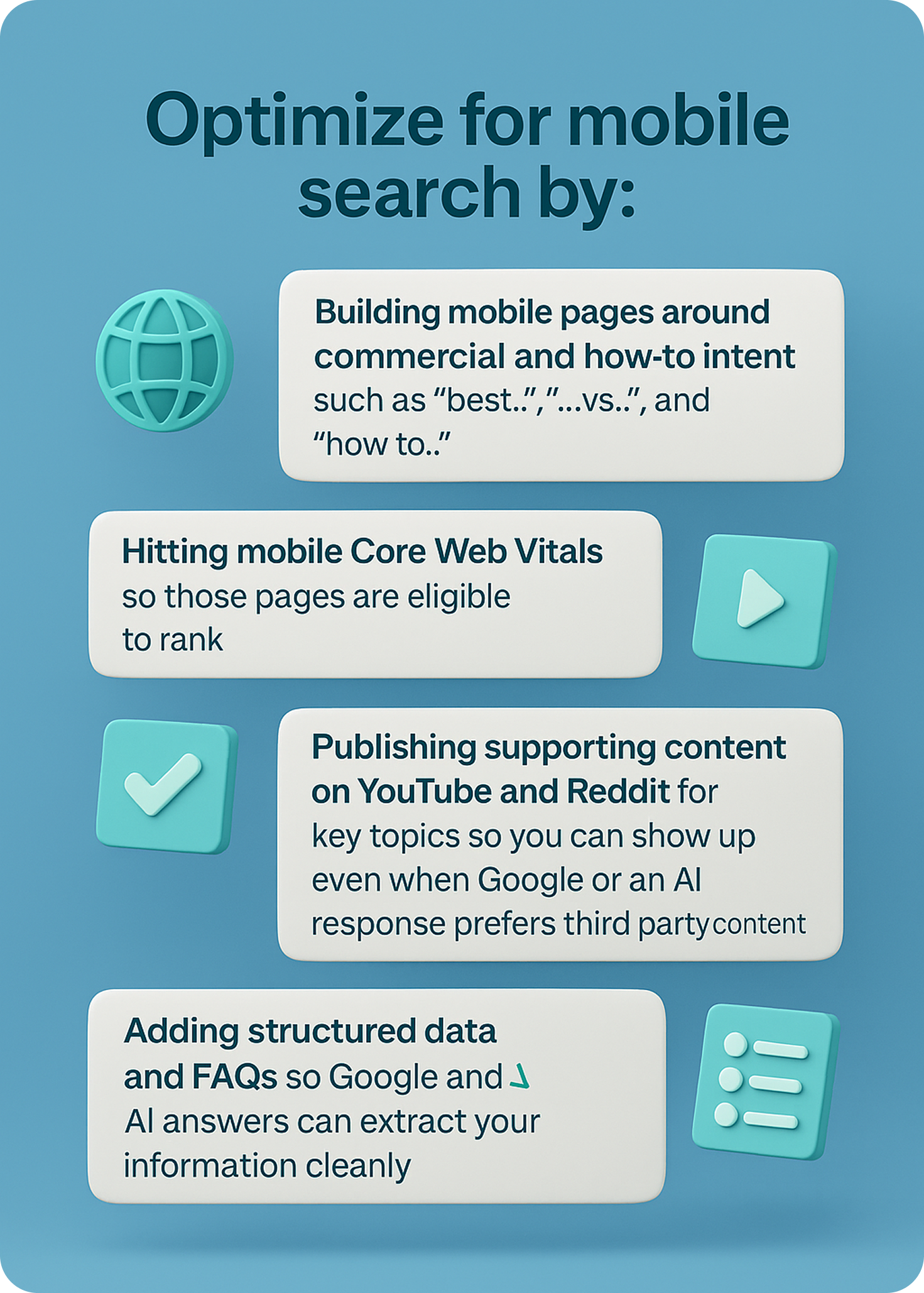
Optimize for mobile search by:
- Building mobile pages around commercial and how to intent such as “best…”, “…vs…”, and “how to…”
- Hitting mobile Core Web Vitals so those pages are eligible to rank
- Publishing supporting content on YouTube and Reddit for key topics so you can show up even when Google or an AI response prefers third party content
- Adding structured data and FAQs so Google and AI answers can extract your information cleanly
When that content drives traffic back to your site, it still fires your pixel. Those non paid signals help Axon improve delivery on the paid side.
4. Use Messaging Where Intent Is High (SMS, WhatsApp)
SMS and WhatsApp are still the highest attention mobile channels, but they only work when they are tied to behavior. That means sending a message because someone abandoned a cart, browsed a category, or bought once but did not return, not just because you scheduled a blast.
In practice, use SMS for order updates, time sensitive offers, or restocks. Use WhatsApp for conversational commerce where Meta’s Business API is available. If you are running Axon on the paid side, you can use its pixel events to define who is high intent and then let your marketing automation handle the actual outreach. Paid finds the right people and messaging closes the gap.
Use messaging to:
- Trigger abandon cart, browse abandon, or back in stock flows
- Deliver time bound offers to people who already engaged on site
- Keep lists opt in only to protect deliverability and trust
5. Make Video Native to Mobile, Not Repurposed
Short, vertical, under 60 second creative is still what performs on mobile. TikTok, Reels, Shorts, and in feed video inside ad platforms all reward content that hooks in the first two to three seconds and makes the product obvious. That is the creative you should also upload into Axon so it can rotate based on engagement.
The important part in 2026 is not only creating video, but giving the ad platform enough variations to suppress fatigue. Static image, short product video, and a UGC style explainer should all be in rotation. Platforms such as Axon can then use engagement and conversion metrics to push the best one without you rebuilding campaigns manually.
For mobile video:
- Shoot vertical first
- Lead with product or payoff, not a brand montage
- Upload multiple variants so the ad platform can rotate and suppress fatigue
6. Use Context and Location Without Getting Creepy
Location still matters for mobile, especially for brands with stores, events, or local offers. Basic geofencing, where a user enters an area and receives a message or promo, still works. More advanced setups use location clusters or time of day patterns as part of audience construction.
Because 2026 is even more privacy aware than previous years, this has to be done with transparency. Axon, for example, uses location clusters as one of its contextual signals without relying on user level identifiers. That is the model to follow. Use context to improve relevance, not to track individuals.
Good uses of context:
- Local promotions tied to store radius or event locations
- Time of day or day of week adjustments for delivery
- Contextual targeting in Axon that uses clusters, not individuals
7. Build a Measurement Stack That Assumes Imperfect Data
This is the part most teams skip. SKAN will stay incomplete. Meta will stay harder to read. Browser and platform privacy changes will continue. Your mobile marketing strategy has to work even when event coverage is 70 to 80 percent and not 100 percent.
Practically, that means choosing one optimization goal such as ROAS, cost per purchase, or installs and engagement for app flows and wiring every surface to feed that goal. Use a pixel and Conversions API for web. Use SDK events and SKAN for app. Let the ad platform model, in this case Axon, learn from what it actually receives. Then monitor at the aggregate level, such as blended CAC, blended ROAS, and retention by cohort. You cannot fix privacy, but you can make your stack resilient to it.
.png)
To make this work:
- Standardize events across web and app so models see consistent signals
- Report at the aggregate level, not only per channel
- Let Axon optimize on the signals it actually gets
Conclusion: Mobile Growth in 2026 Is Signal First
Mobile growth in 2026 is not about finding one magic channel. It is about building a mobile setup that continues to work even when platforms change what they surface, what they track, and what they let you see.
If you get the basics right, such as mobile web first, SEO that also shows up on YouTube and Reddit, behavior tied messaging, mobile native video, and a measurement model that assumes imperfect SKAN and Meta data, you can still scale.
That is where a platform such as Axon fits. It gives you a model that can learn from the signals you actually have, including pixel events, contextual data, and SKAN postbacks, and turns that into performance without manual audience building. That allows you to spend more time on content, offers, and creative and less time trying to reverse engineer opaque algorithms.

Learn how to make UGC video ads that actually convert on Axon by AppLovin. Covers ideal length, hook structure, caption strategy, and the creative patterns driving real ROAS in 2026.

Discover how mobile incrementality testing in 2026 proves true ad impact. Learn from Axon case studies showing higher iROAS, stronger LTV, and halo effects across channels.