
How to Optimize Axon Campaigns for Predictive Monetization and ROAS Growth
How to Optimize Axon Campaigns for Predictive Monetization and ROAS Growth
AppLovin’s Axon is an AI-powered advertising platform that helps advertisers improve campaign performance by predicting user value, automating bidding, and adapting to SKAN attribution. This guide explains how Axon works, what it optimizes, and how to use it to scale efficiently — with real-world results across gaming, ecommerce, and DTC websites.
What Axon Optimization Actually Means
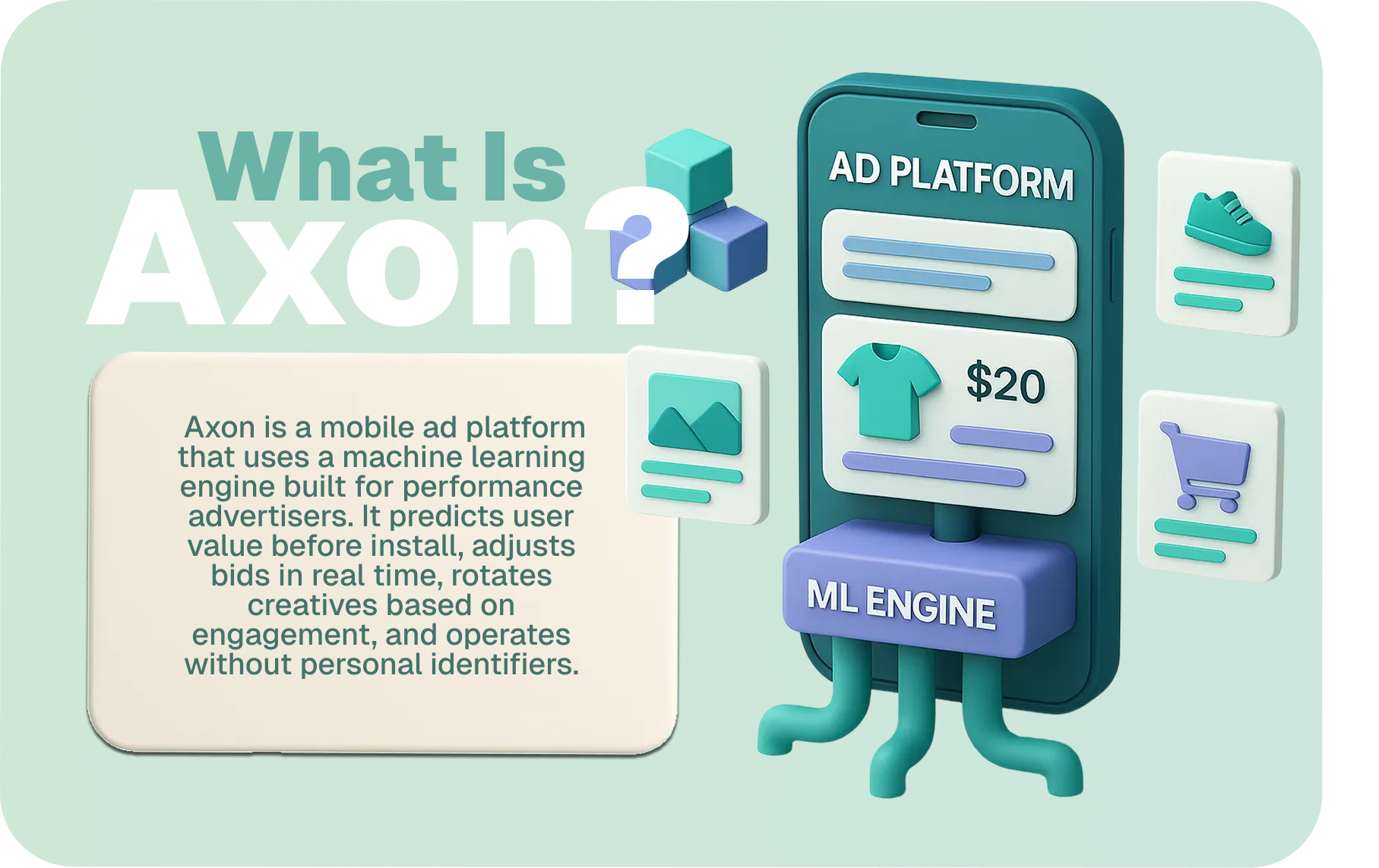
Axon optimization is about using machine learning to make smarter decisions at scale. Instead of relying on manual tweaks or static targeting, Axon analyzes aggregated performance signals to prioritize spend on impressions most likely to convert. It adjusts bids, rotates creatives, and adapts to privacy constraints — all in real time.
Since iOS stopped sharing device-level data (IDFA), advertisers now rely on modeled conversions and probabilistic attribution. Axon was built for this shift.
IDFA (Identifier for Advertisers) is a device-level identifier used by Apple to help advertisers track and measure user interactions across apps. Since iOS 14.5, users must explicitly opt in to allow apps to access their IDFA, making it less reliable for targeting and attribution. Most modern ad platforms now rely on aggregated, privacy-safe signals instead.
How Axon Uses Predictive Monetization to Improve ROAS
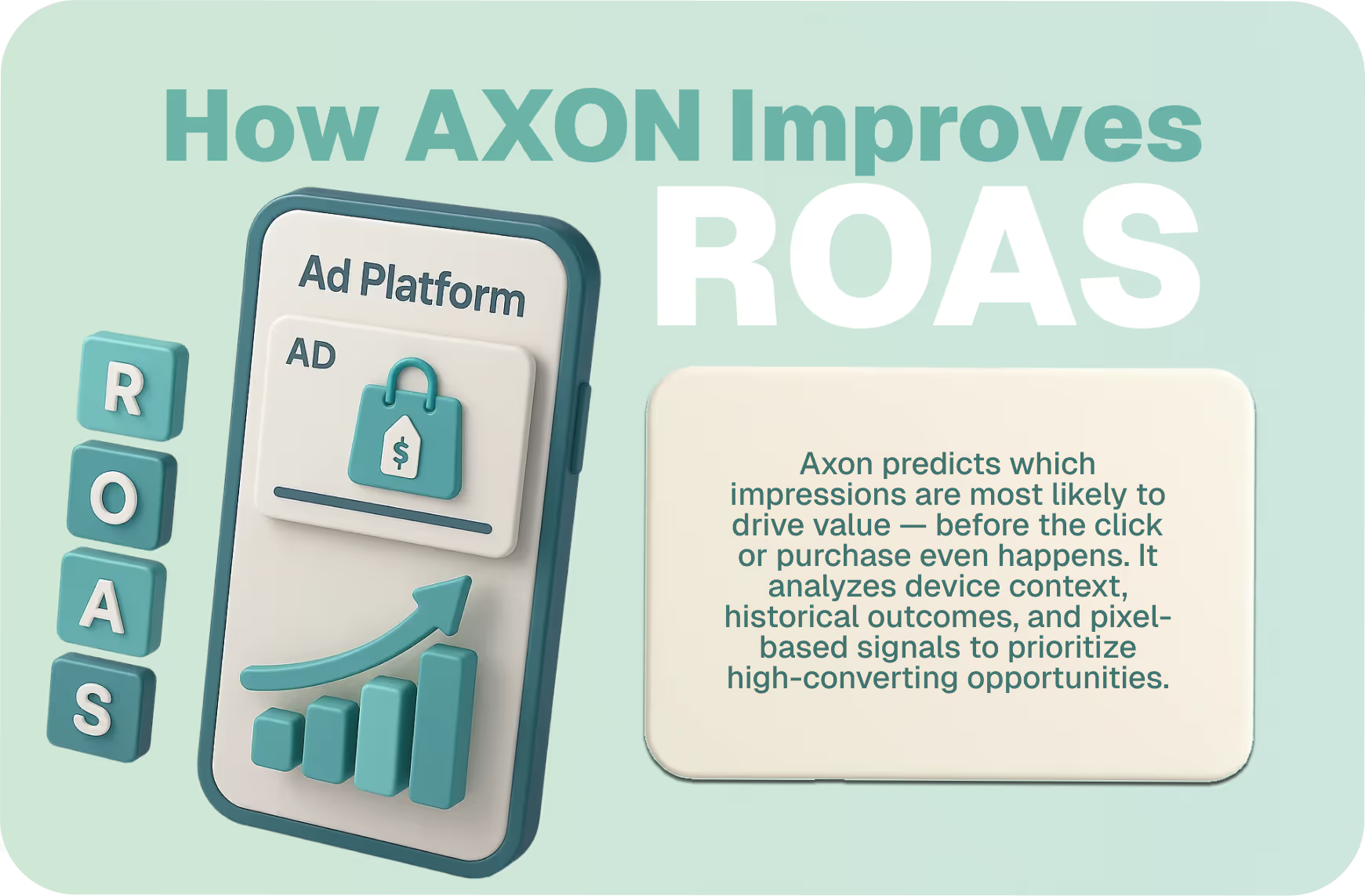
Axon predicts which impressions are most likely to drive value — before the click or purchase even happens. It analyzes device context, historical outcomes, and pixel-based signals to prioritize high-converting opportunities.
Instead of waiting for delayed feedback, Axon makes real-time decisions based on modeled outcomes. That means faster learning cycles, stronger ROAS, and fewer wasted impressions.
Example: Predictive bidding adjusts spend hourly based on real conversion probability, so budgets shift automatically toward the channels that deliver the highest ROAS.
According to AppLovin’s Q2 2025 report, Axon contributed to a 77% YoY revenue increase and 81% operating margins — driven by its ability to automate and scale performance across both mobile and web.
Real-Time Bidding and Signal-Based Adjustments
Axon’s optimization engine reacts in real time. It adjusts bids dynamically based on user context, device type, location, and engagement likelihood. This is especially critical in a post-IDFA world, where deterministic targeting is no longer reliable.
Real-time bidding allows Axon to shift budget toward high-performing geos, creatives, or audience segments without manual input. It continuously learns and adapts, making it ideal for lean teams that need results without overhead.
SKAN Attribution: How Axon Handles iOS Signal Loss
Apple’s privacy changes forced advertisers to rethink how they measure performance. With IDFA gone, SKAN became the new standard — but it’s delayed, aggregated, and often incomplete.
Axon trains its models directly on SKAN postbacks, so it can optimize campaigns even when event data is limited. This leads to smarter attribution, faster learning cycles, and better decision-making in low-signal environments.
Contextual Targeting Without IDFA
Axon uses contextual signals like device type, app usage patterns, location, and time of day to predict user behavior. It doesn’t guess — it learns from aggregated behavior and adjusts campaigns accordingly.
Conversion Windows and Modeled Events
SKAN attribution comes with strict conversion windows and limited postbacks. Axon works within those constraints by modeling conversion events based on historical data and behavioral trends. It can optimize for installs, purchases, or other post-install actions — even when SKAN only provides partial feedback.
Best Practices for Axon Optimization
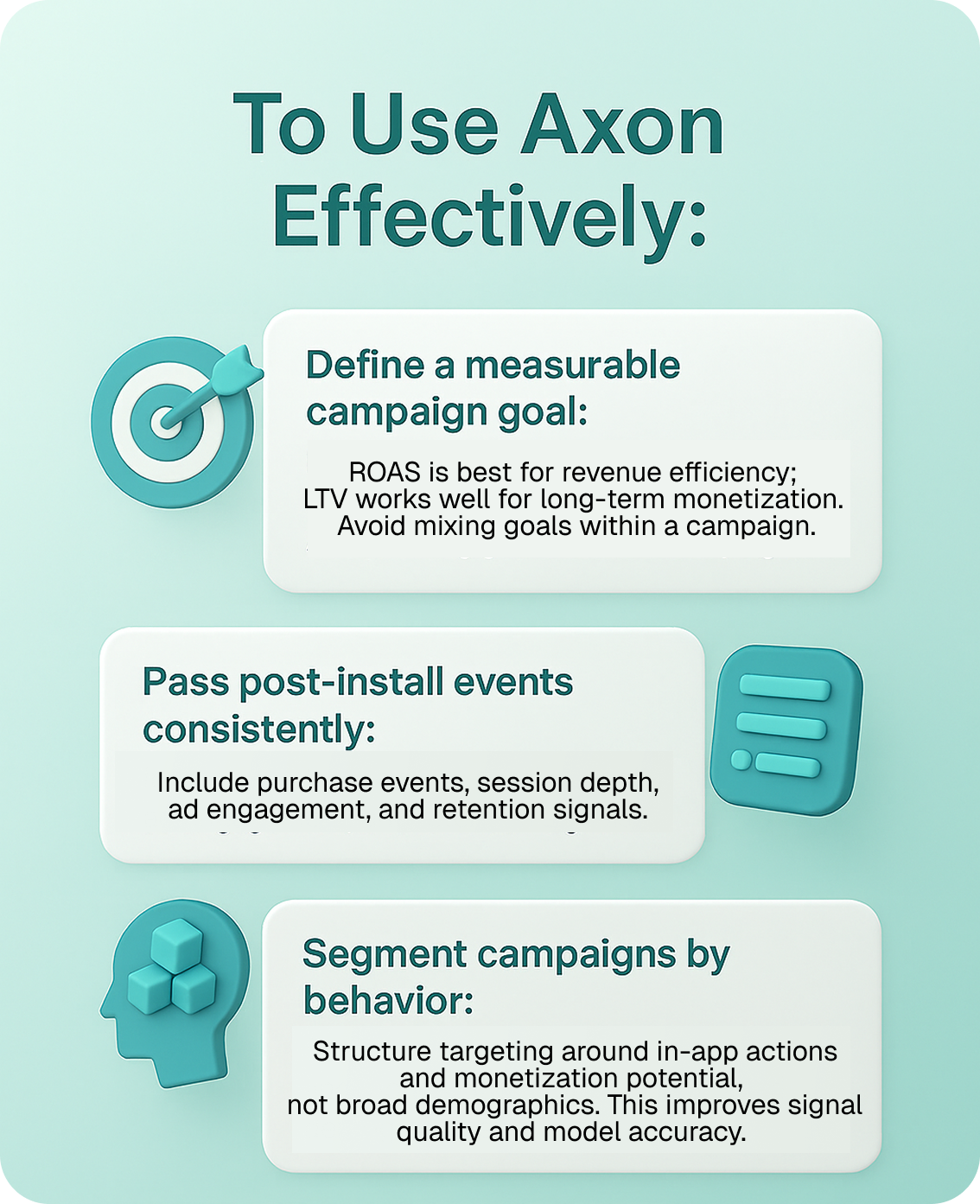
Axon is powerful, but it performs best when set up intentionally. Here’s how to help it learn faster and deliver stronger results.
Set the Right Campaign Goal
Axon thrives on clear, conversion-based signals. Choose the goal that matches your business model:
- App campaigns: Optimize for installs or post-install events like purchases or subscriptions.
- Web campaigns: Optimize for CPP (Cost Per Purchase) or ROAS (Return on Ad Spend), using pixel-based tracking.
Each Axon account supports either app or web campaigns — not both — so choose the right setup from the start.
Creative Rotation and Fatigue Prevention
Creative fatigue is one of the fastest ways to tank performance. Axon automatically rotates creatives based on real-time engagement data. If an ad starts underperforming, it gets deprioritized before it drags down results.
Best practices:
- Upload 3–5 creative variants per campaign
- Refresh assets every 1–2 weeks
- Monitor CTR and conversion rate to identify early signs of drop-off
Leverage multiple formats: Axon supports static images, short-form video, interactive overlays, and Dynamic Product Ads (DPAs). DPAs allow ecommerce brands to serve personalized product creatives based on catalog data — ideal for showcasing inventory, pricing, or promotions at scale.
To maximize DPA performance:
- Keep your product catalog fresh and up-to-date
- Ensure product images and metadata are clean and conversion-ready
- Use clear CTAs like “Shop Now” or “Limited Offer” to drive urgency
What Results Can You Expect from Axon Optimization
Axon is a performance engine. When properly integrated, it delivers measurable improvements in ROAS, creative engagement, and campaign efficiency.
How quickly will you see results?
Axon begins learning immediately once your campaign launches. Most advertisers see early performance signals within 24–72 hours. Full optimization typically stabilizes within 7–10 days, depending on budget, signal quality, and goal alignment.
How often should you optimize?
Axon handles most adjustments automatically, but strategic oversight still matters.
- Weekly: Review ROAS, CPP, and creative performance
- Biweekly: Refresh creatives and rotate new variants
- Monthly: Reassess campaign goals and budget allocation
Optimization isn’t a one-time setup — it’s a rhythm. The more consistently you feed Axon strong inputs, the better it performs.
ROAS Improvements in Gaming and Ecommerce
Gaming apps and ecommerce websites are especially sensitive to ad performance. CPIs and CPPs fluctuate daily, creative fatigue sets in fast, and conversion efficiency is everything.
Axon identifies high-value users before the click or install, then optimizes delivery based on predicted conversion value. In gaming, that means acquiring users likely to engage deeply. In ecommerce, it means prioritizing audiences more likely to browse, add to cart, and purchase — all tracked via pixel-based signals.
Performance Under SKAN and Limited Signal Conditions
Axon was rebuilt to thrive in SKAN environments. It uses contextual signals — like device type, app usage patterns, and time of day — to model user behavior and optimize campaigns without relying on IDFA.
This keeps campaigns adaptive even when user-level data disappears.
What Advertisers Usually Ask Next
Once your Axon campaign is up and running, a few common questions tend to surface — especially as performance starts to scale. Below are the most frequent things advertisers ask once they’ve seen early results and want to fine-tune their strategy.
What creatives work best with Axon? Short-form video, interactive end cards, static images with clear CTAs, and Dynamic Product Ads all perform well. The key is variation — Axon automatically detects fatigue and prioritizes top performers.
Can Axon optimize campaigns across multiple geos? Yes. Axon uses contextual signals like device type, language, and region-specific engagement trends to adjust bids and creative delivery by geo.
Is Axon suitable for small teams? Absolutely. Axon was designed for lean UA teams. It automates bidding, creative rotation, and performance optimization, reducing manual overhead and freeing up time for strategy.
Does Axon support retargeting? No. Axon is focused on user acquisition and predictive monetization — not traditional retargeting. It does not support audience uploads or segmentation for retargeting purposes.
Axon vs Manual DSP Optimization
AppLovin’s Axon and platforms like Moloco represent two distinct approaches to campaign optimization: one built for speed and scale, the other for precision and customization.
Axon vs Moloco: Automation vs Granular Control
Axon automates everything — bidding, creative rotation, audience targeting, and post-install optimization. It uses predictive modeling to identify high-value users and adjust campaigns in real time, without manual input.
Moloco offers DSP-style control. You can manually set bid strategies, segment audiences, and test creatives with precision. It’s ideal for advertisers with rich first-party data and the resources to manage campaigns hands-on.
The trade-off: Axon delivers speed and adaptability. Moloco offers control and customization. If your team needs to move fast and optimize at scale, Axon is built for that. If you want to experiment deeply and fine-tune every lever, Moloco gives you the sandbox.
Smarter Optimization Starts Here
Attribution gets murky. Creatives burn out. What worked last quarter stops delivering. Axon helps you adapt faster.
It’s not just automation. It’s a system that learns, reacts, and improves — without constant babysitting. Whether you’re scaling a game, pushing purchases for an ecommerce site, or trying to stretch your budget, Axon gives you a real edge.
👉 Check it out at axon.ai and see what predictive optimization really looks like in action.
Sources & References
Learn how to make UGC video ads that actually convert on Axon by AppLovin. Covers ideal length, hook structure, caption strategy, and the creative patterns driving real ROAS in 2026.
Discover how mobile incrementality testing in 2026 proves true ad impact. Learn from Axon case studies showing higher iROAS, stronger LTV, and halo effects across channels.