

In-App Advertising Examples for Ecommerce Brands
In-App Advertising Examples: How Ecommerce Brands Run Ads Inside Mobile Games
If you have ever tried to explain in-app advertising to someone who has not run it before, you know the conversation gets abstract fast. Unskippable full-screen ads. Interactive end cards. Dynamic catalogs. It all sounds interesting until someone asks: " Okay, but what does it actually look like?
That is what this article is for. Instead of talking about in-app advertising in theory, we are going to walk through the real formats, real creative approaches, and real examples of how ecommerce brands are running ads inside mobile games on Axon by AppLovin today. Not what is possible in principle, but what is actually working.
If you are already running on Axon, this gives you a clearer picture of what your competition is doing and what you might be missing. If you are new to the platform, it is the fastest way to understand what the format actually demands from you before you spend anything.
First: What In-App Advertising Actually Looks Like on Axon
Before getting into examples, it helps to understand the canvas. Axon's ads run inside mobile apps, predominantly games, across a wide range of genres. Most run for 30 to 60 seconds. The user is mid-session in a game, not scrolling a feed, which means their attention is more focused than it is on any social platform.
The ad experience on Axon is not just a video. It is a sequence: the video plays, then the user lands on an interactive end card where they can engage with an offer or browse products, and from there they can tap through to your site to complete a purchase. For brands with a product catalog, Dynamic Product Ads can surface personalized recommendations inside that end card experience.
That three-part structure, video, interactive page, catalog is what makes Axon different from a simple video ad buy. The brands getting the most out of it are the ones treating all three stages as part of a single creative brief, not just uploading a video and hoping for the best.
Example 1: The Full-Funnel Explainer (Best for New Customer Acquisition)
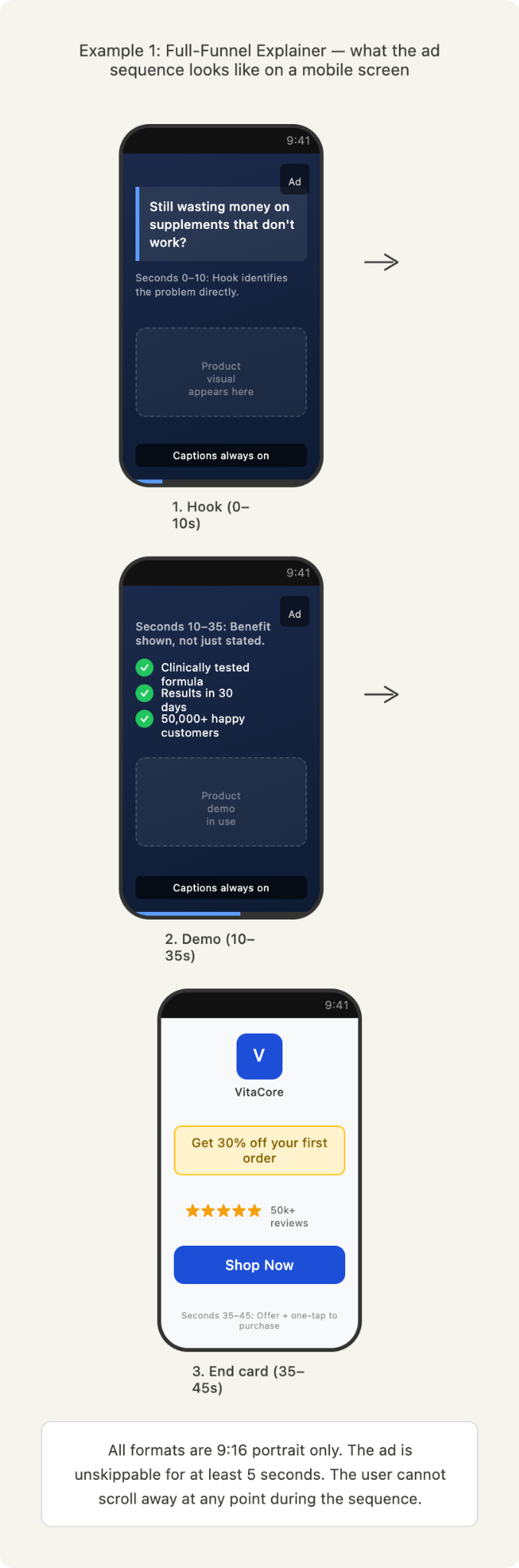
This is the format the Axon team points to most consistently when brands ask what performs well for cold traffic. The structure is straightforward: the video identifies a problem the viewer likely has, demonstrates the product as the solution, and ends with a clear offer before handing off to the interactive end card.
What makes it work on Axon specifically is the format. On Meta or TikTok, a 45-second video explaining your product is a risk because users can scroll away the moment they lose interest. On Axon, the unskippable window gives you time to actually build the case. Brands selling products that need context, anything where the benefit is not obvious from a single image, tend to see strong results with this format.
What it looks like in practice:
- Seconds 0 to 10: A hook that identifies the problem. Not a logo, not a brand intro. The first line is about the viewer.
- Seconds 10 to 35: Product demonstration with a clear benefit shown, not just stated. Captions throughout.
- Seconds 35 to 45: Offer and CTA. A specific reason to act now, not a generic call to visit the site.
- End card: Interactive page reinforcing the offer with a single tap to purchase.
Skincare, supplements, home goods, kitchen products, and fitness equipment all see this format consistently outperform shorter, less explanatory cuts on Axon.
Example 2: The UGC Testimonial (Best for Trust-Building at Scale)
UGC-style creative, meaning a video that looks like it was filmed by a real customer rather than a production team, is one of the most durable formats on Axon. The reason is simple: when someone is sitting inside a game, and an ad appears, polished brand advertising reads as advertising. A person talking directly to the camera about a product they actually use reads differently.
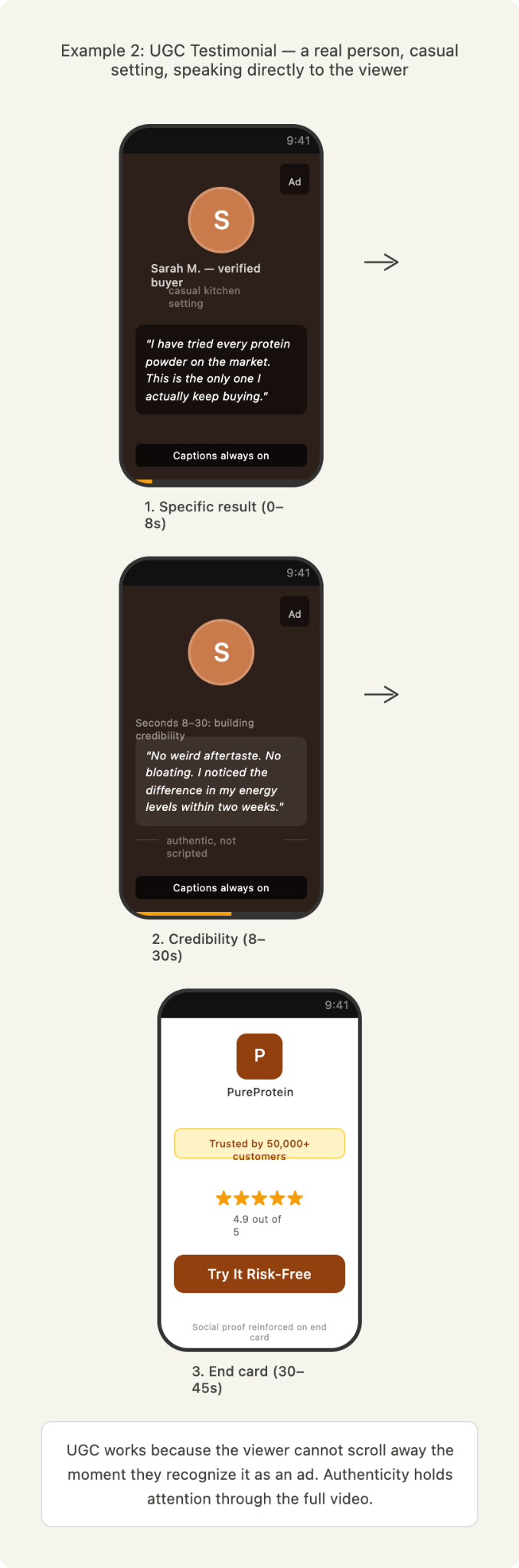
The Axon team notes that UGC-driven value propositions resonate especially well in the unskippable format because the viewer cannot scroll away the moment they recognize it as an ad. A real person speaking with genuine conviction about a product has enough credibility to hold attention through the full video.
What it looks like in practice:
- A single person on camera, casual setting, speaking directly to the viewer.
- Opens with a specific result or outcome, not a general endorsement. "I have tried every protein powder and this is the only one I actually keep buying" lands better than "I love this product."
- 30 to 45 seconds. Long enough to build credibility, short enough to stay tight.
- Captions are non-negotiable here. Many users are playing with sound off.
One thing to test: multiple UGC creators covering the same product with different angles. Different voices resonate with different segments of the audience, and Axon's algorithm will figure out which version is driving conversions and allocate spend accordingly.
Example 3: The Dynamic Product Ad (Best for Multi-SKU Ecommerce)
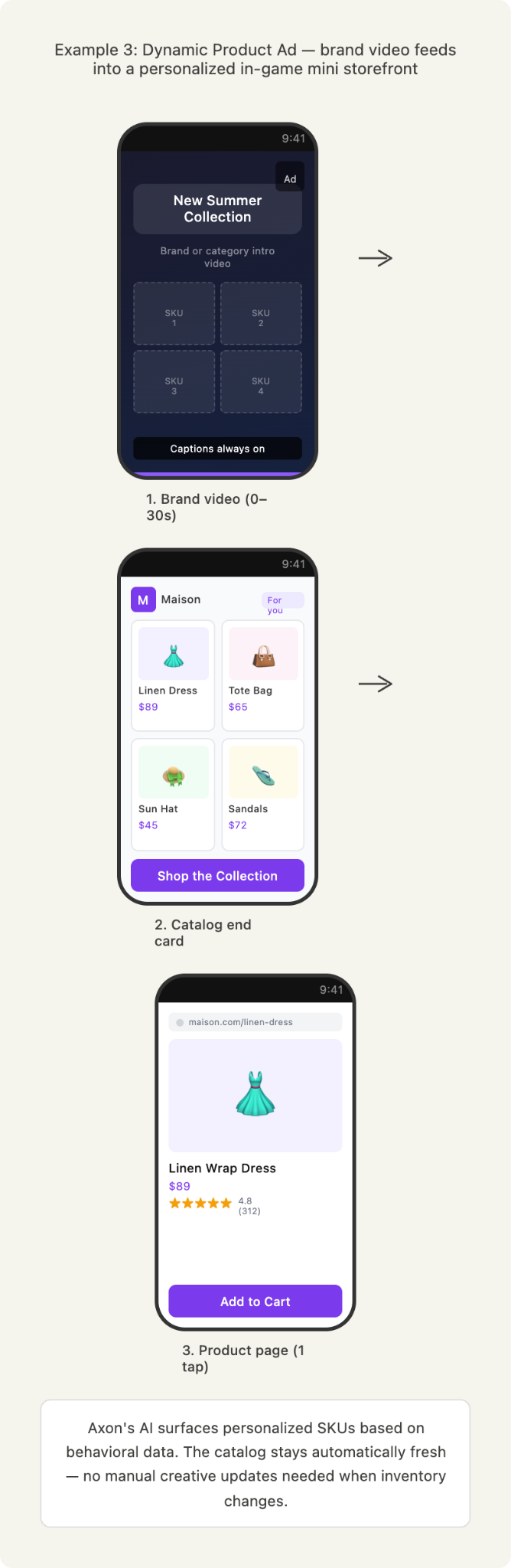
If you are running a store with five or more SKUs, Dynamic Product Ads are one of the highest-leverage tools available on Axon. The video portion introduces the brand or a product category, and then the interactive end card surfaces personalized product recommendations pulled directly from your catalog.
This is not the same as a generic catalog ad. Axon's AI matches the product recommendations to what it knows about the user's behavior, which means someone who has shown intent around a specific type of product is more likely to see the SKUs most relevant to them, not just your bestsellers.
What it looks like in practice:
- The video acts as a brand or category introduction. Think of it as the top of the funnel within the ad unit itself.
- The interactive end card becomes a personalized mini storefront where users can browse products and tap directly through to your product page. The user can scroll through product options and tap directly through to the product page.
- Product images need to be clean and high contrast. The end card is smaller than a full screen, so busy lifestyle imagery loses detail.
Fashion, home decor, beauty, and apparel brands with rotating inventory see strong results with this format because the catalog integration keeps the creative automatically fresh without requiring constant manual updates.
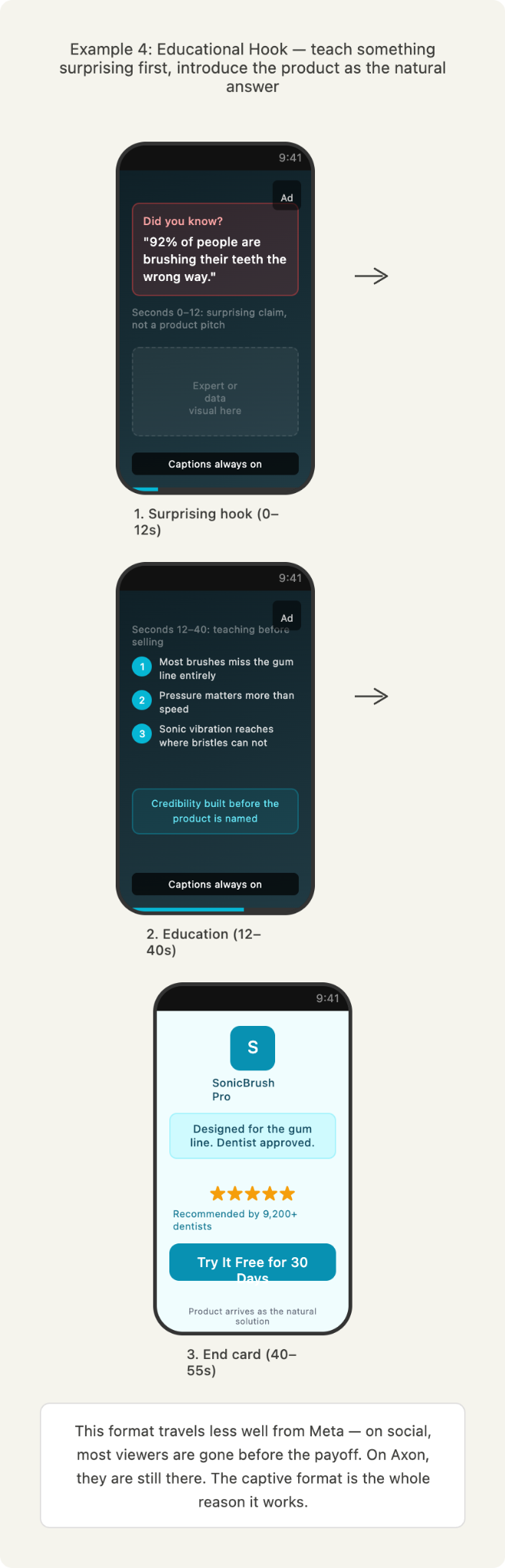
Example 4: The Educational Hook (Best for Complex or Considered Products)
Some products need explanation before they can sell. If a viewer does not understand what your product does or why it is different, no amount of strong CTAs will move them. For those categories, the educational hook format is one of the most effective in-app advertising approaches available.
The idea is to lead with something the viewer does not already know, a surprising fact, a common mistake, a counterintuitive insight, and use that to open the door to the product. The Axon team calls this out specifically as a format that works exceptionally well in the captive, unskippable environment because you have enough time to actually teach something before making an ask.
What it looks like in practice:
- Opens with a stat, a myth, or a question the viewer likely has not considered. "Most people brush their teeth wrong" is a hook. "Our toothbrush is better" is not.
- The middle of the video delivers the information, building credibility before the product is even introduced.
- The product arrives as the natural solution to whatever problem or gap was just introduced.
- Works especially well for health, wellness, finance, and tech-adjacent products where the buyer needs to trust before they buy.
This format travels less well from Meta than the others because on social, most viewers are gone before the payoff arrives. On Axon, they are still there.
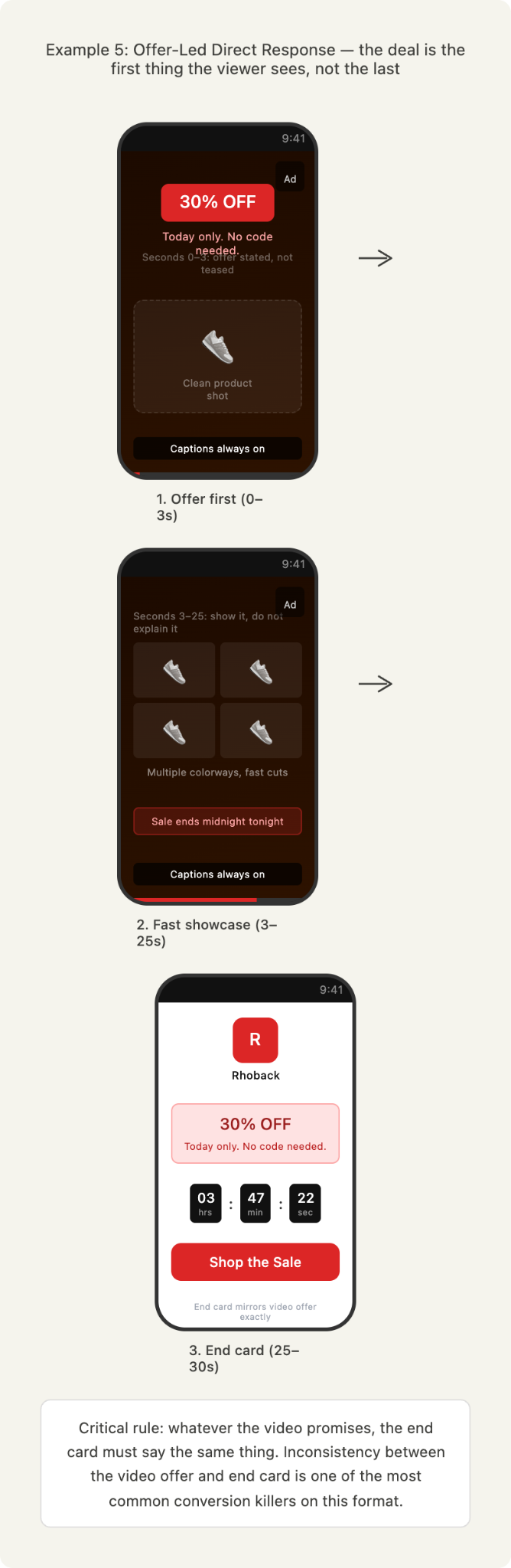
Example 5: The Offer-Led Direct Response Ad (Best for Promotions and Seasonal Pushes)
Not every campaign needs to be a brand story. Sometimes the product is well known enough, or the offer is strong enough, that the most effective creative is the most direct one: lead with the deal and make it easy to act.
Offer-led ads work particularly well during promotional periods, product launches, and seasonal pushes where the buyer is already in a purchasing mindset. The creative does not need to do heavy lifting on education or trust because the offer itself is doing the conversion work.
What it looks like in practice:
- The offer is in the first three seconds. Not teased, stated. "30% off, today only" is a hook.
- Product visuals are clean and fast. The job of the middle section is to show the product clearly, not explain it.
- The end card mirrors the offer exactly. If the video says 30% off, the end card says 30% off. Inconsistency between the video promise and the end card kills conversion.
- The CTA is specific. "Shop the Sale" outperforms "Learn More" every time on a direct response unit.
One important note: While you generally aren’t advised to pause campaigns, you should pause creatives focused on a specific promotion once that promotion ends. Outdated offer ads, especially ones mentioning a sale that has passed, are one of the most common creative mistakes the Axon team sees. Outdated offer ads, especially ones mentioning a sale that has passed, are one of the most common creative mistakes the Axon team sees. They not only stop converting, but they also actively erode trust.
What All of These Examples Have in Common
Different formats, different products, different funnel stages. But the underlying principles are consistent across every in-app advertising example that performs well on Axon:
- Portrait format only. Axon does not support landscape. Every creative in these examples is 9:16, full screen.
- Captions on every video. A large portion of the audience is playing with sound off. Videos without captions are leaving engagement on the table.
- 30 seconds or longer. Short clips underutilize the attention advantage that makes Axon worth running in the first place.
- Message parity between video and end card. Whatever promise the video makes, the end card has to keep it.
- Volume and variety. None of these brands are running one creative and hoping it works. They are uploading 10 or more assets across multiple formats and letting Axon's algorithm identify what converts.
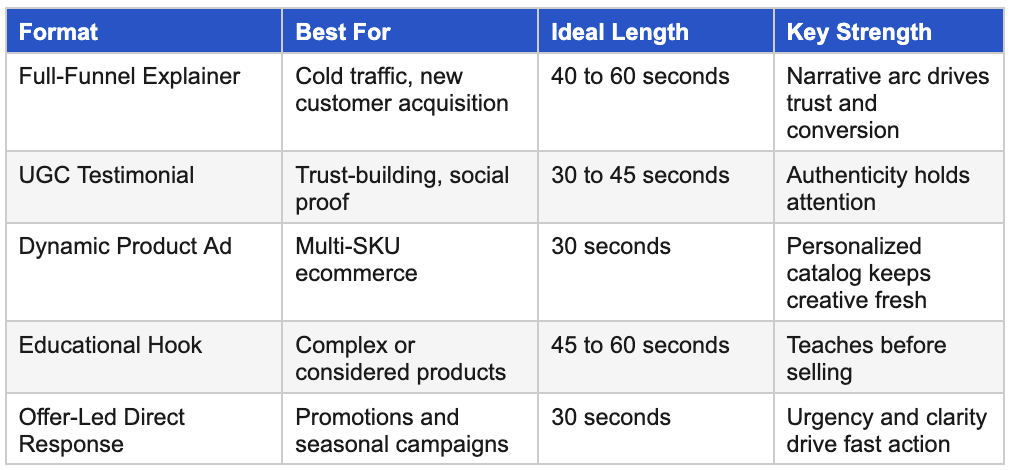
Quick Reference: Which Format Fits Your Campaign?
Where to Go From Here
Seeing examples is useful. Knowing how to execute against them is where the real work happens. A few articles that go deeper on the specifics:
- For creative testing strategy: What Creative Performs Well on Axon
- For campaign setup and pixel best practices: In-App Advertising Best Practices for 2026
- For understanding how Axon's full-funnel campaign types work: Discovery vs Prospecting Campaigns in Axon
- For ROAS tracking and performance metrics: AppLovin Axon Performance KPIs
- For understanding who Axon reaches and why: Why Mobile Gaming Audiences Convert for Ecommerce
See What Is Actually Working
Join Axon Insiders to get access to real creative breakdowns, campaign case studies, and the benchmarks that the top ecommerce brands on Axon are using to make decisions. The Slack community is where practitioners share what is converting right now, not six months ago.
FAQs
What ad formats does Axon support?
Axon supports portrait video ads (9:16, up to 60 seconds), image ads for interactive end cards, and HTML assets built through Axon's Creative Studio. All formats are vertical only. Landscape is not supported.
Does Axon work for ecommerce brands that are not in gaming?
Yes. Axon's inventory runs inside mobile apps, but some of the advertisers are ecommerce brands across a wide range of categories including fashion, beauty, home goods, health, and fitness. The gaming environment is where the ads run, not a restriction on who can advertise.
How long should in-app video ads be on Axon?
30 to 60 seconds is the sweet spot. Videos shorter than 30 seconds underuse the attention advantage Axon's unskippable format provides. The platform's average impression time is longer than other paid media channels, and brands that build for it see stronger results.
Do I need a big production budget to run on Axon?
No. UGC-style content, meaning video filmed simply by a creator or customer, consistently performs well on the platform. In many cases it outperforms polished brand production because it feels more credible in the gaming environment. What matters more than production quality is message clarity and creative volume.
Can I run the same creative I use on Meta?
The DNA of strong Meta creative, good hooks, clear value props, authentic storytelling, translates to Axon. But the format is different enough that direct repurposing rarely gets the best results. Meta creative is built to stop a scroll in one second. Axon creative can build over 30 to 60 seconds because the viewer is not going anywhere. Adjusting pacing and narrative length for the unskippable format makes a meaningful difference.
How many creative variations should I test?
Start with at least 10 video assets and 10 image or interactive page assets. Campaigns with wider creative variety consistently outperform narrow ones on Axon. The algorithm allocates spend toward what is converting, but it needs enough variety to learn from. Think of your creative set as an ongoing library, not a fixed batch.
See real in-app advertising examples from ecommerce brands running ads inside mobile games on Axon by AppLovin.

Mobile game advertising reaches over 1 billion daily users with full-screen, unskippable ads. Here is why ecommerce brands are finding new customers on Axon by AppLovin and how to set up for real results.
.png)