

Why Mobile Gaming Audiences Convert for Ecommerce
Why Mobile Gaming Audiences Convert for Ecommerce: The Opportunities Behind In-App Ads
There is a version of this conversation that starts with a pitch. But if you are a performance marketer, you have heard enough pitches. So let us start with the thing nobody says out loud: most ecommerce brands that have not tried mobile game advertising are avoiding it based on a picture that stopped being accurate years ago.
Banner ads buried inside a free puzzle game. Low-quality placements. Audiences that do not buy. That was a fair description of mobile in-app advertising circa 2015. It is not what Axon by AppLovin is.
What Axon actually is: a full-screen, unskippable ad environment reaching over 150 million Americans daily and more than a billion users globally inside social gaming apps where attention is not split across a feed. It is one of the largest attentive media environments on the planet, and for ecommerce brands, it is still largely uncrowded.
Why Attention Is the Actual Problem
Every channel you are already running has the same bottleneck: you get about one second to stop someone before they move on. That is true on Meta, TikTok, YouTube pre-roll, and anywhere else where the content keeps flowing if someone does not engage.
Gaming is different. When someone is mid-session on a mobile game, they are not passively scrolling through a feed. They are locked in. Axon's ads run full-screen and unskippable, with users giving at least 30% of their undivided attention to what is playing.
That is the actual differentiator. Not just that users are paying attention, but that you can move them from that attention directly into a purchase flow. The platform's data shows 70 to 80% of conversions happen within the first hour of a click. This is not a brand awareness play dressed up as performance. It is a direct response.
The Audience Question (It Is Not Who You Think)
The "mobile gamers do not buy" assumption dies fast when you look at who is actually playing. Casual and social gaming, which is the environment where Axon's inventory lives, skews toward adults with real purchasing power. Commuters. Parents. People killing time between meetings or winding down at night.
More importantly, roughly 80% of the conversions Axon generates are new customers to the brand. That is not a coincidence. It is a function of who the platform reaches. These are not people who have already bought from you and are showing up again in your Meta retargeting. They are net new buyers you were not finding anywhere else.
Axon's AI runs on 12 years of behavioral data from this audience, drawing on actual purchase behavior across a billion-plus daily active users. So even when you are targeting cold audiences, the model has deep signal on who is likely to transact. Cold targeting, warm data.
What the Ad Experience Actually Looks Like
This is where Axon gets genuinely interesting from a creative standpoint, because it is not just video ads. The full experience goes from video to interactive end card to dynamic catalog ad. In one session, a user can go from watching a 30 to 60 second product video to browsing your actual catalog, all without leaving the game.
That is a full-funnel journey compressed into a single ad unit. Awareness, consideration, and purchase intent all in one uninterrupted experience. It is why Axon describes its format as combining TV's attention with paid social's performance and commerce's conversion mechanics. It is not an exaggeration.
For brands wondering how their Meta creative translates: it is not a 1:1 transfer, but the DNA carries over. Strong hooks, clear value props, and UGC-style storytelling all work here. What changes is that you are not fighting for thumb-stop time. The ad is unskippable for at least 5 seconds, so you can actually build a narrative. Longer-form storytelling, educational angles, and full-funnel explainers perform on Axon in ways they cannot on Meta because the format does not give users the option to leave.
Anecdotally, the Axon team sees brands have more success starting with their Meta creatives than their TikTok ones. Worth keeping in mind if you are deciding where to pull assets from first.
The Misconceptions Holding Brands Back
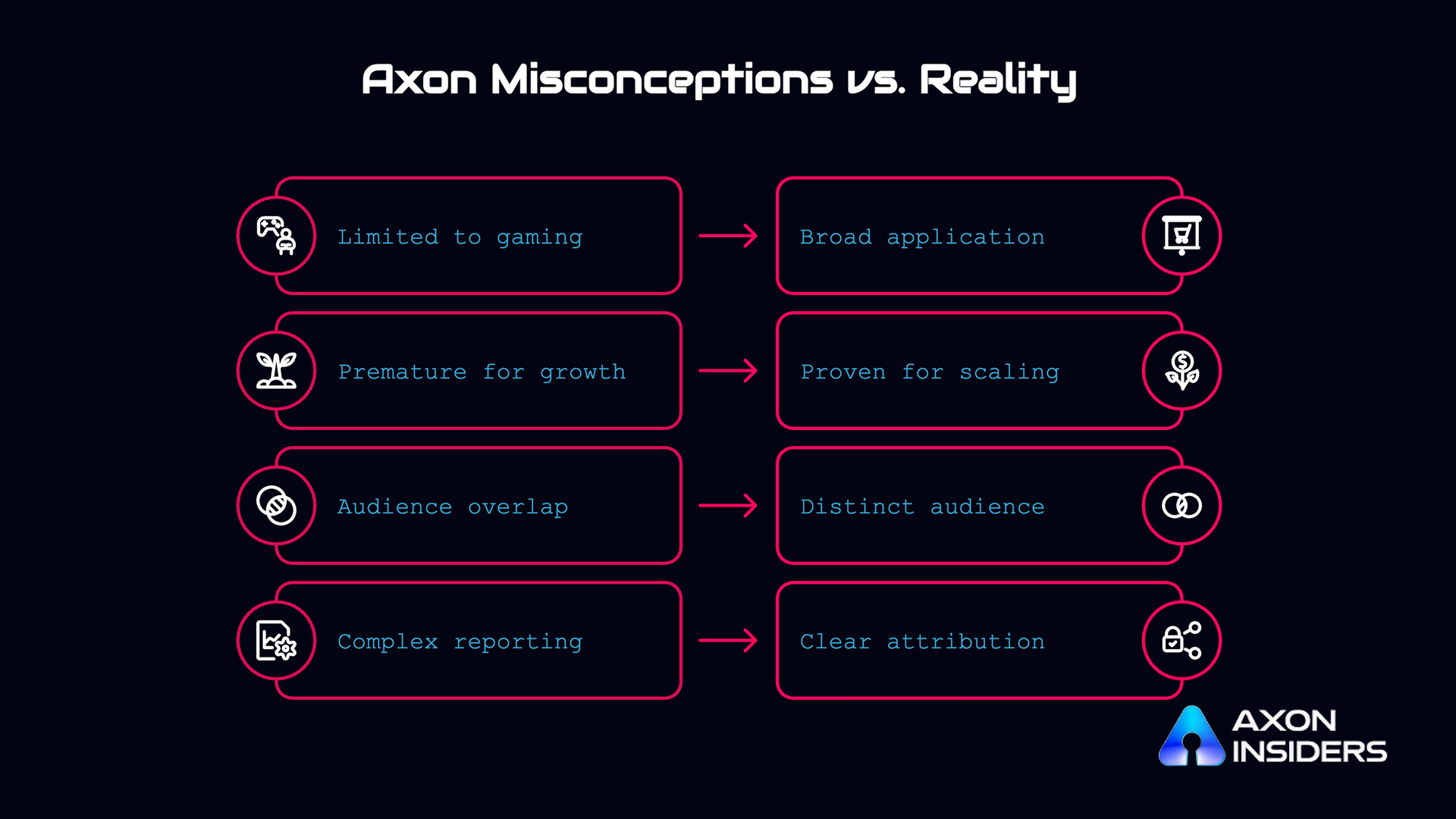
A few things the Axon team hears repeatedly that are not true:
- "It is only for gaming apps." Axon runs web campaigns for ecommerce brands, including Shopify stores, DTC brands, and multi-SKU catalogs. App install campaigns are one use case, not the only one.
- "It is too early to scale." Brands are already running seven-figure monthly budgets on Axon with strong iROAS. This is not a testing channel.
- "The audience overlaps with Meta." It largely does not. Axon's inventory comes from social gaming environments, which is a distinct pool. You are not bidding against yourself.
- "Reporting works like other platforms." Worth knowing: Axon uses click-only attribution with no view-through windows muddying your numbers. The conversions in your dashboard are ones you can verify in your third-party tracking tool.
Is This Actually Right for Your Brand?
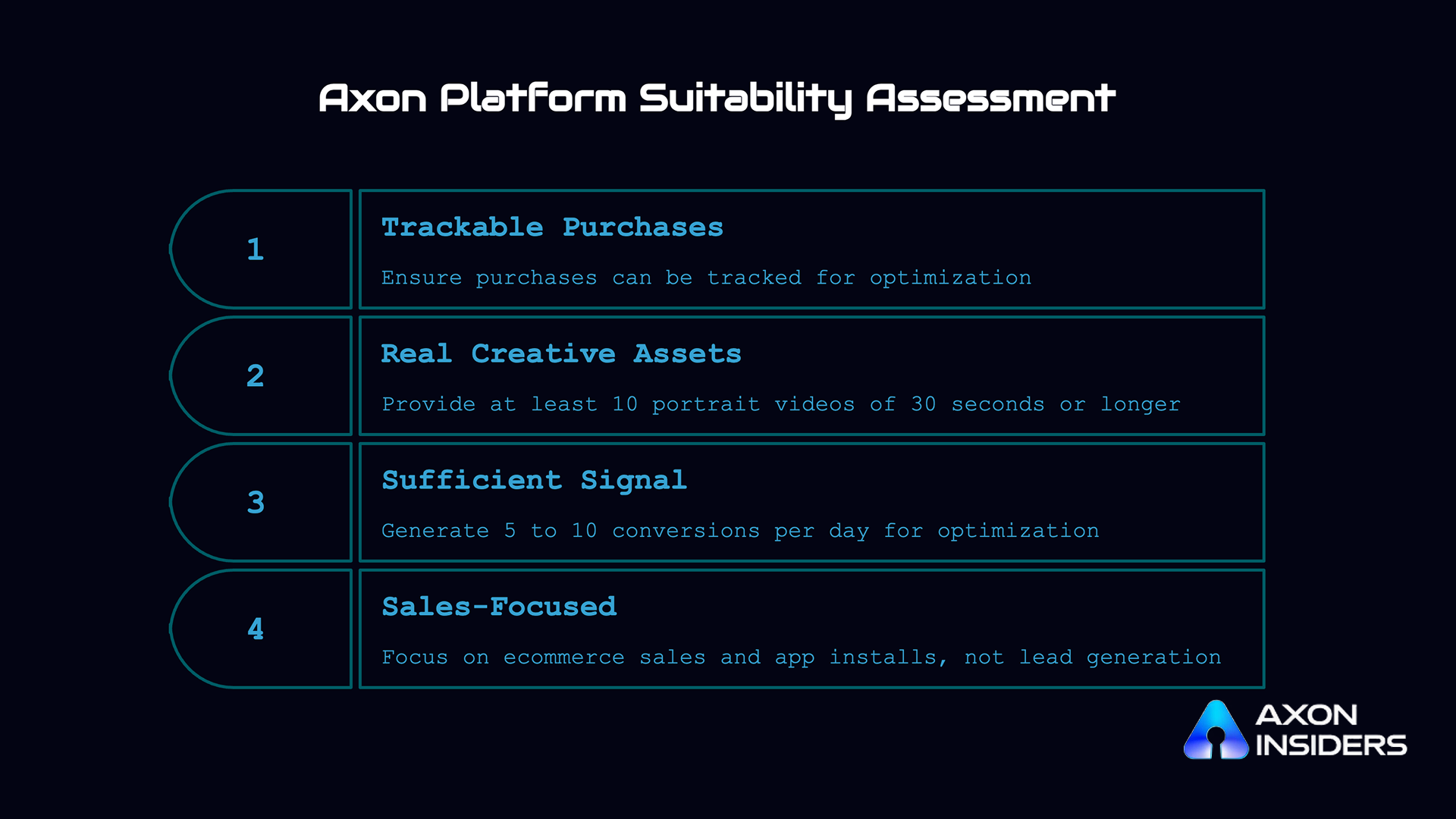
Like any performance channel, Axon works best when certain conditions are in place. Here is what tends to separate brands that scale quickly from those that struggle:
- You can track purchases. Axon optimizes toward measurable conversion events. No trackable purchase event means no optimization. That sounds obvious, but it rules out a meaningful chunk of lead-gen-first businesses.
- You have real creative. The platform wants at least 10 portrait videos, 30 seconds or longer. Not repurposed landscape cuts. Not static images only. If you do not have video assets, build them first.
- You can generate enough signal. The model needs at least 5 to 10 conversions per day to optimize properly. Budget needs to be calibrated to your AOV. A $1,000 product needs more daily budget than a $40 one to get there.
- You are selling, not collecting leads. Pure lead generation is not a current use case. Axon is built for ecommerce sales and app installs.
Getting Setup Right (Where Most Brands Stumble)
The Axon team is consistent about what goes wrong early: pixel setup and creative volume. Those are the two things that determine whether the platform can do its job.
On pixel: if you are on Shopify, the integration is clean. If you are not, and you are setting up through GTM, it is worth taking extra time here. The most common failure point is events not firing correctly, especially purchase events with revenue values. If the system cannot see your full funnel, it cannot identify your customers at scale.
On creative: more is genuinely better. Campaigns with wider creative variety consistently outperform narrow ones. The Axon team has seen up to a 25% lift in purchases from brands that upload more assets rather than cherry-picking perceived winners. The instinct to funnel all spend into one top performer actually hurts performance on this platform, because creatives that do not get last-click credit are still contributing to the conversion path.
Practically speaking, what you want to launch with:
- 10 or more portrait videos, 30 to 60 seconds long, with captions. Videos with subtitles substantially outperform those without.
- 10 or more image assets or interactive pages built in Axon's Creative Studio.
- A connected catalog if you are running multi-SKU.
- A strong hook in the first 5 to 15 seconds, but do not sacrifice the rest of the video for it.
One more thing on timeline: give the campaign 14 to 28 days before drawing hard conclusions. The model needs conversion data to learn. Cutting it short because of daily fluctuations is one of the most common ways brands underestimate what Axon can do.
Where This Fits in Your Channel Mix
Most brands using Axon are running it alongside Meta and Google, not instead of them. The audiences do not overlap much, so you are not cannibalizing existing conversions. You are opening a new acquisition lane.
The smarter brands are running it sequentially. Discovery Campaigns go first, targeting people who have never been to your site and expanding your addressable audience. Then, Prospecting Campaigns convert the warm visitors who came but did not buy. It is a deliberate full-funnel sequence that gives you more control over new customer acquisition than Universal campaigns alone.
For a deeper look at how those two campaign types work together, the piece on Discovery vs. Prospecting Campaigns covers it in detail.
The broader point: in a media environment where Meta CPMs keep climbing and Google's audience signals are thinning, mobile game advertising through Axon is one of the few places left where performance marketers are finding genuinely new buyers at scale, in an environment where the audience is actually paying attention.
The Bottom Line
Mobile game advertising is not a side experiment for brands with extra budget. For ecommerce advertisers who get the inputs right, meaning clean pixel, strong creative volume, and enough budget to generate signal, Axon is a real acquisition channel with reach that Meta and Google are not providing.
The audience is larger than most people assume. The attention is guaranteed. The conversion mechanics are built for direct response. And the competitive set inside gaming inventory is still a fraction of what you are fighting on social feeds.
The brands that figure this out early have a real head start. The question is whether yours is one of them.
Join Axon Insiders before your competitors do. Get exclusive access to the benchmarks, case studies, and scaling playbooks that the top ecommerce brands on Axon are already using to grow in 2026.
FAQs
What is mobile game advertising?
Mobile game advertising means serving ads inside mobile gaming apps. On Axon, those ads run full-screen and unskippable during natural breaks in gameplay, which means higher attention and more direct conversion behavior than most digital formats.
Does Axon work for ecommerce brands, or just gaming companies?
Both. Axon runs web campaigns optimized for ecommerce purchases alongside app install campaigns for gaming and non-gaming apps. Ecommerce brands connect via the Axon pixel, set a ROAS or CPP goal, and the algorithm handles targeting and bidding from there.
How is Axon different from Meta for ecommerce?
The audience pool is largely distinct since Axon reaches users through social gaming, not social feeds. The ad format is full-screen and unskippable, so viewability is guaranteed rather than competed for. And attribution is click-only with no view-through windows, which makes results easier to verify in third-party tools.
What ROAS can I expect?
There is no single benchmark since ROAS varies too much by vertical, creative quality, and AOV to give a platform-wide number. The most useful comparison is within your category. Brands running Prospecting Campaigns specifically have reported 75% or more improvements in new customer KPIs.
Can I run Axon at the same time as Meta and Google?
Yes, and most brands do. Because Axon's audience is distinct, it adds incremental reach rather than overlapping with existing campaigns. Many advertisers run incrementality tests to confirm Axon's contribution alongside their other channels.
How do I get access?
Axon is invite-only for new advertisers. Axon Insiders has partnered with the team to issue invite codes to qualified brands. You can apply directly through the site.
See real in-app advertising examples from ecommerce brands running ads inside mobile games on Axon by AppLovin.
Mobile game advertising reaches over 1 billion daily users with full-screen, unskippable ads. Here is why ecommerce brands are finding new customers on Axon by AppLovin and how to set up for real results.
.png)