

Discovery vs Prospecting Campaigns in Axon
.png)
Discovery vs Prospecting Campaigns: an Axon Insider Guide
It’s 2026 and Axon is continuing its fast pace of releasing mobile ad innovations. What started as a way for e-commerce brands to tap into mobile in-app inventory - reaching over 150 million Americans daily and a billion users worldwide - has quickly become one of the most talked-about ad platforms in performance marketing. And they're not slowing down. Earlier this year they rolled out Prospecting Campaigns, giving advertisers a dedicated way to target new customers. Now they've followed it up with Discovery Campaigns, pushing even further up the funnel.
Two new campaign types in quick succession. Both focused on growth, but target different end results. Understanding the granular differences between them is the key to getting the most out of each one and the Axon platform.
What Are Prospecting Campaigns?
Prospecting Campaigns were introduced by Axon as a dedicated campaign type for web and e-commerce advertisers who want to prioritize new customer acquisition.
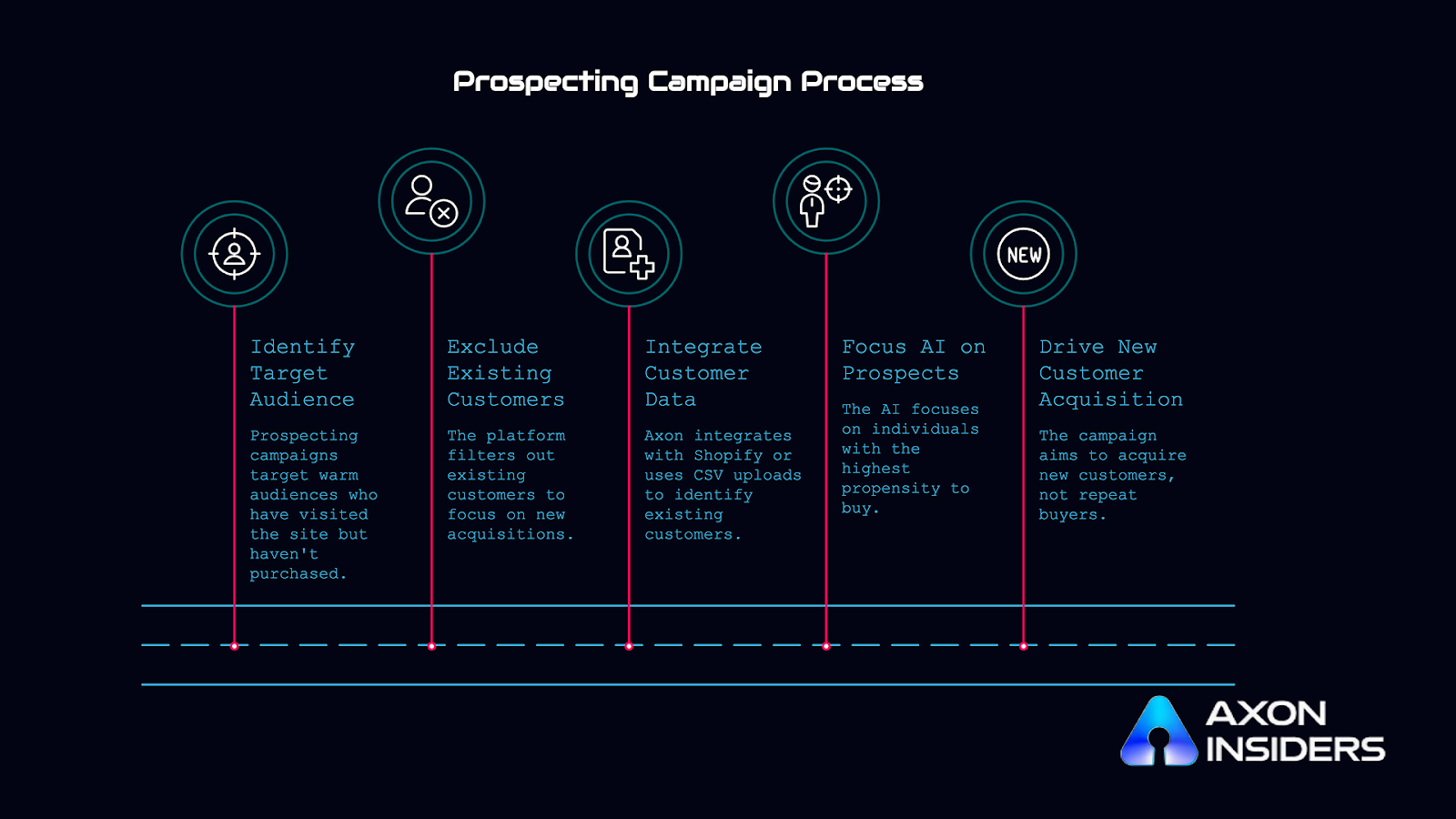
Here's the core idea: Prospecting Campaigns target people who have already visited your site but haven't made a purchase yet. These are warm audiences - they've browsed your products, maybe added something to a cart, maybe bounced from your landing page. They know who you are. They just need a nudge to convert.
That's what makes Prospecting Campaigns so effective. You're not starting from scratch. You're focusing Axon's AI on the people with the highest propensity to buy and filtering out existing customers so every dollar goes toward genuinely new revenue. The key metric here is new customer acquisition - not LTV, not repeat purchase rate. Pure first-time buyers. And the platform already skews heavily in that direction - as Pep Hufen of Smart Marketer Agency points out, roughly 80% of the conversions Axon generates are new customers to the brand.
To make this work, Axon needs to know who your existing customers are. If you're on Shopify, the integration handles this automatically. If not, you upload your historical purchase data via CSV - typically covering the past two years - so the model can distinguish between returning buyers and fresh prospects.
In early tests, brands with naturally high repeat purchase rates saw significant improvements in new customer KPIs. That makes sense: if 40% of your conversions are repeat buyers, Prospecting Campaign mode filters them out so the algorithm hunts exclusively for first-time purchasers.
For a deeper look at how advertisers are using this in practice, we covered the rollout and early performance data in our piece on Prospecting Campaigns in Axon.
What Are Discovery Campaigns?
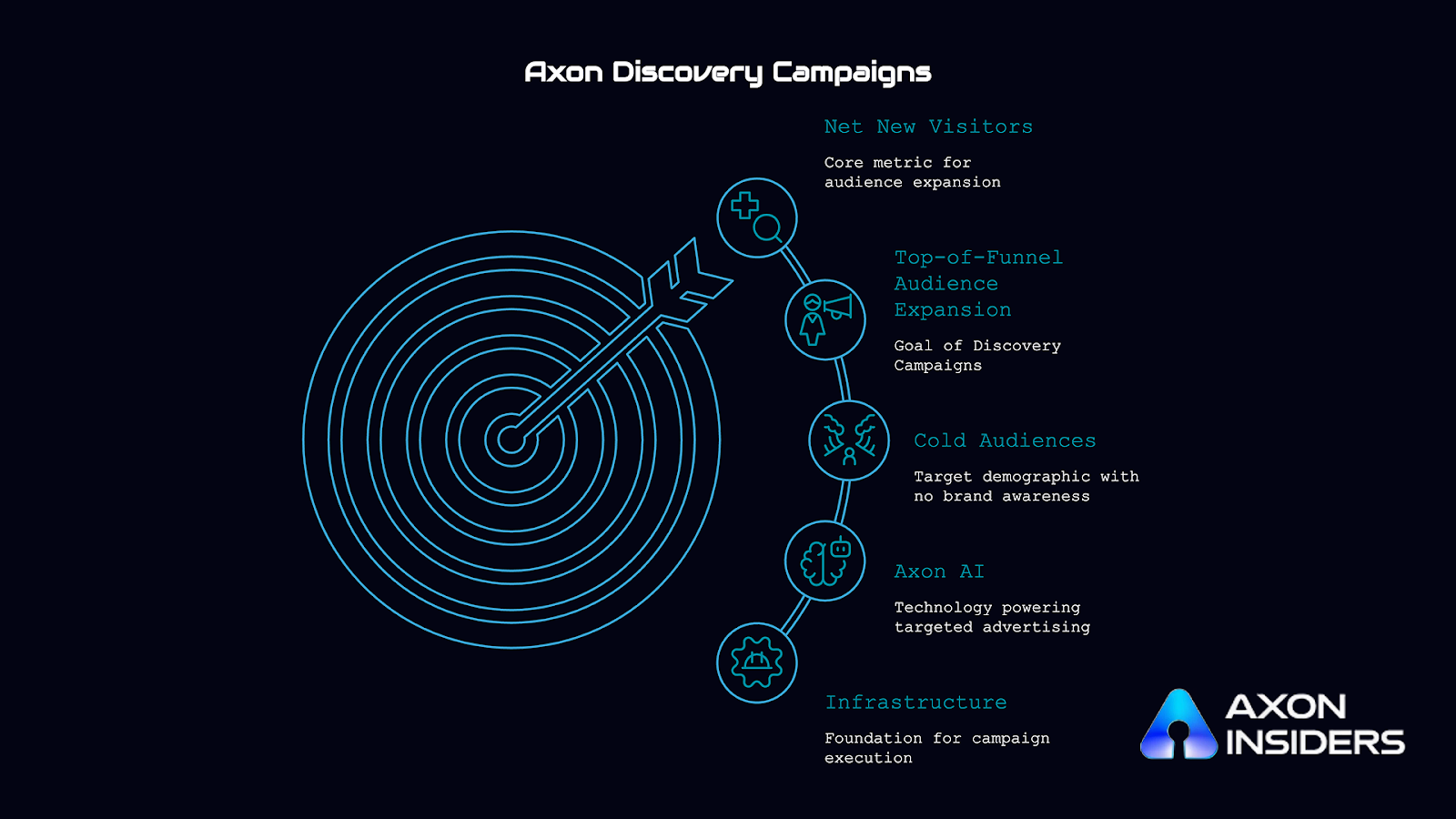
While Prospecting Campaigns convert warm visitors into first time buyers, Discovery Campaigns target people who have never even visited your site before. Discovery Campaigns go after people who have never even visited your site. Announced by Axon as the natural complement to Prospecting Campaigns, Discovery is pure top-of-funnel audience expansion.
These aren't people who browsed and bounced. They're people who have zero awareness of your brand. They've never hit your landing page, never seen your product pages, never interacted with you in any way. Discovery's job is to change that.
The key metric here is net new visitors - not conversions, not ROAS. You're measuring how effectively you're expanding your addressable audience. Are you reaching people who would never have found you otherwise? Discovery gives you a direct answer.
What gives Discovery a real edge here is what's powering it under the hood. Axon's AI is built on 12 years of behavioral data - not just demographics, but actual purchase behavior from over a billion daily active users. That means even when targeting completely cold audiences, the model has deep signal on who is likely to transact. It's cold targeting backed by warm data.
The Axon engineering team built Discovery on the same infrastructure as Prospecting Campaigns, so if you're already running Prospecting Campaigns, there's no additional setup required. Alpha tests showed strong increases in new visitor percentages, which is exactly what you'd expect when you're deliberately pushing into uncharted territory.
The Key Differences at a Glance
Prospecting Campaigns
Discovery Campaigns
Audience
Warm visitors - people who have been to your site but haven't purchased
Cold audiences - people who have never visited your site at all
Key metric
New customer acquisition
Net new visitors
Funnel stage
Mid-funnel - converts interested visitors into first-time buyers
Top-of-funnel - expands your addressable audience
Audience temperature
Warm - they know your brand, just need a nudge
Cold - zero prior awareness of your brand
Data requirements
Historical purchase data (Shopify integration or CSV upload)
Same - historical purchase data via Shopify or CSV
Best for
Brands with high repeat purchase rates leaking budget to existing customers
Brands that have maxed out their current audience and need fresh traffic
The Sequencing Play (This Is Where It Gets Interesting)
Here's what the smartest advertisers in the Axon Insiders community have figured out: Discovery and Prospecting Campaigns aren't just two options you choose between. They're two stages of a sequence.
First, Discovery drives net new visitors to your site - people who had no idea you and your SKUs even existed. Some of them will convert on their first visit. But most won't. They'll browse, maybe poke around a few product pages, and leave.
But now you’ve achieved at least one touch and those visitors are warm. They've been to your site. They know your brand. And that means they're eligible for Prospecting Campaigns, which are specifically built to convert site visitors who haven't purchased yet. And given that 70-80% of Axon conversions happen within the first hour after a click, the handoff from Discovery to Prospecting can move fast.
Discovery first, Prospecting second. Discovery expands the pond. Prospecting catches the fish.
This is a fundamentally different approach from running Universal campaigns alone. Universal optimizes for the most efficient conversion regardless of whether that person is new or returning. The Discovery-to-Prospecting sequence gives you intentional control over the full acquisition journey - from first impression to first purchase.
Industry data backs up this kind of layered approach. According to AdRoll's State of Digital Advertising Report, prospecting CPMs have been trending upward as more advertisers compete for top-of-funnel audiences, which makes having a dedicated pipeline to feed those audiences increasingly valuable. And as Smart Insights' 2026 digital marketing trends analysis highlights, the brands winning with AI-driven optimization aren't just letting algorithms run - they're defining clear stage-specific objectives for the AI to optimize against.
That's exactly what this sequence does. You're giving Axon's AI a precise job at each stage: find me people who've never been here (Discovery Campaigns), then convert the ones who came but didn't buy (Prospecting Campaigns).
Setting Yourself Up for Success
Whichever campaign type you choose, the fundamentals stay the same. Make sure your purchase data is clean and comprehensive - the model is only as good as the signal you feed it. Monitor your new-customer metrics closely in the first few weeks as the algorithm learns. And don't panic if Discovery campaigns take longer to optimize than Prospecting Campaigns ones; wider audiences need more data to converge.
One thing that makes measuring all of this easier: Axon uses click-only attribution - no view-through windows muddying the data like you might see on Google or Meta. That means the conversions you're seeing in your dashboard are real, trackable actions you can verify in your third-party tracking tool.
If you want to go deeper on the metrics that matter, our guide to AppLovin Axon Performance KPIs walks through exactly which numbers to watch and when to make adjustments.
The Bottom Line
Prospecting and Discovery campaigns aren't competing features - they're complementary halves of a performance acquisition strategy. Discovery fills the top of your funnel with net new visitors. Prospecting campaigns convert those warm visitors into first-time buyers. Together, they give you more granular control than Axon’s Universal campaigns: a deliberate, sequenced path from brand awareness to first purchase.
Learn the major differences between Discovery Campaigns and Prospecting Campaigns on Axon by AppLovin.
.png)
Learn how IDFA works in 2026, when it applies, why user consent matters, and how it fits into modern iOS advertising with SKAN, modeling, and Axon.
.png)