

What is IDFA? iOS Attribution Explained for Advertisers 2026
.png)
What is IDFA? An Advertiser’s Guide for 2026
IDFA is still part of iOS advertising, but it is not something you can rely on across every campaign or every user. Some users allow tracking. Many do not. That means IDFA data is real, but partial.
The challenge for advertisers is understanding what IDFA actually is today, when it can be used, and how it fits into a modern, privacy-first measurement stack.
This guide explains what IDFA is, how it worked historically, what changed with Apple’s privacy updates, where IDFA still adds value, and how it is used alongside platforms like Axon.
What is IDFA?
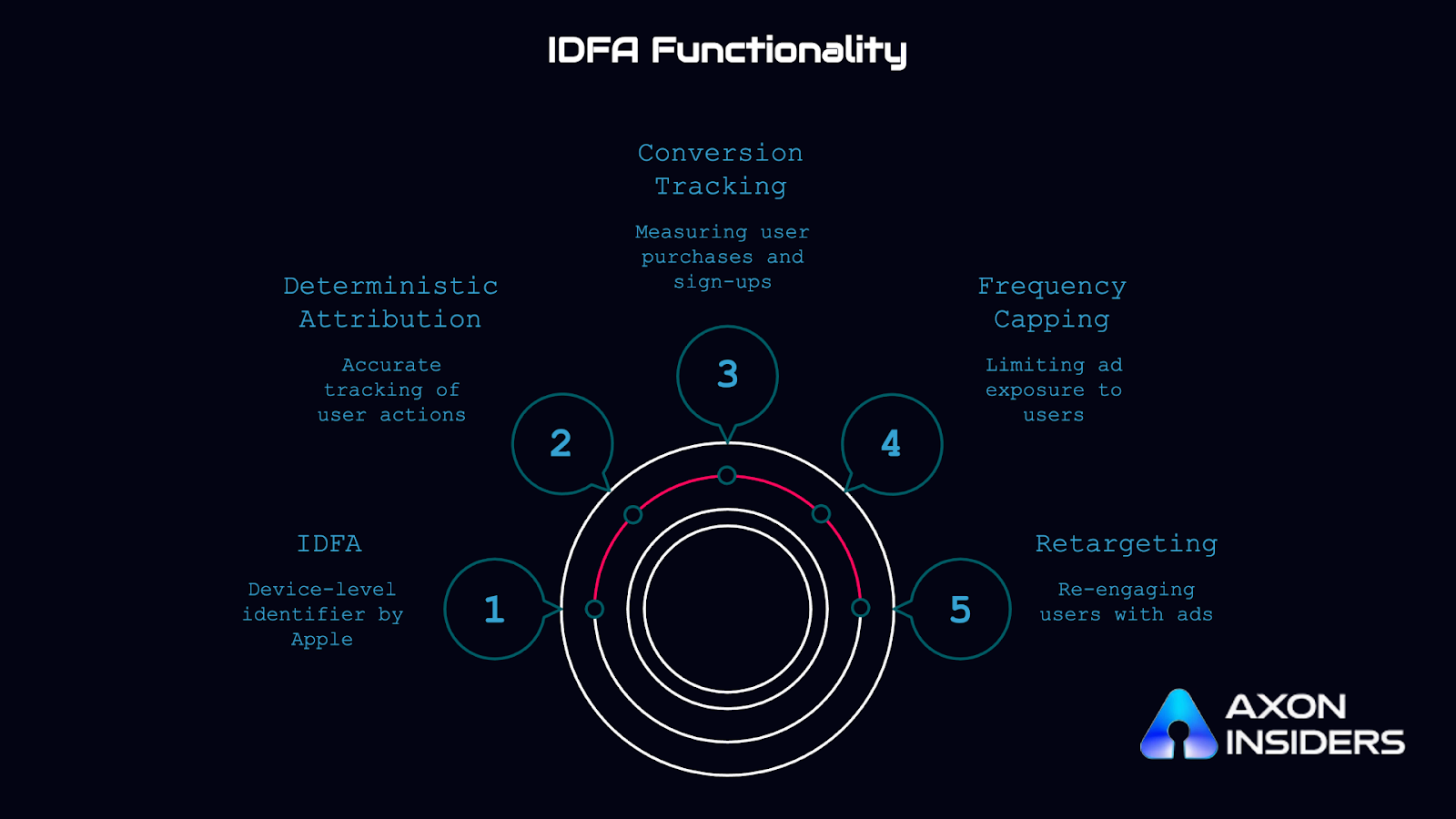
IDFA stands for Identifier for Advertisers. It is a device-level identifier provided by Apple that allows advertisers and ad platforms to recognize the same device across apps.
Historically, IDFA enabled:
- Deterministic attribution
- User-level conversion tracking
- Frequency capping
- Retargeting and re-engagement
- Cross-app measurement
- Fast optimization loops
IDFA is generated and controlled by Apple. Advertisers and ad networks do not create it, and they do not own it. Apple determines when and how it can be accessed.
How IDFA worked before privacy changes
Before Apple introduced App Tracking Transparency, IDFA was available by default unless a user manually disabled tracking at the device level.
In practice, this meant:
- Ads could pass the IDFA automatically
- Installs could be matched deterministically
- Post-install events could be tied directly to users
- Attribution was fast, granular, and scalable
For performance marketers, this model was highly effective. For Apple, it increasingly conflicted with broader privacy goals.
App Tracking Transparency and the IDFA shift
In 2021, Apple introduced App Tracking Transparency (ATT), a privacy framework that requires apps to ask users for permission before tracking their activity across other apps and websites.
Tracking, in this context, means linking user data across companies for advertising and measurement purposes. IDFA is one of the main identifiers used for that type of tracking, which is why ATT directly impacts its availability.
ATT was introduced as part of Apple’s broader shift toward giving users more control over how their data is used. Instead of allowing tracking by default and requiring users to opt out manually, Apple moved to an explicit consent model where users must actively agree before any cross-app tracking occurs.
This is why Apple did not simply make IDFA opt-in at the system level. ATT standardizes how permission is requested, ensures users see a clear prompt, and enforces the rule consistently across all apps.
The critical change:
- IDFA access became opt-in instead of opt-out
If a user declines tracking permission:
- The IDFA is not available
- A zeroed or null value is returned
- User-level attribution using IDFA is not allowed
By 2026, ATT is fully normalized. Users are familiar with the prompt. Opt-in rates vary by region, app category, and messaging, but IDFA coverage is incomplete by design.
What IDFA can do in 2026
IDFA remains a powerful signal when it is available. It simply operates within narrower boundaries.
When a user opts in, IDFA can support:
- Device-level attribution
- User-level conversion analysis
- Faster optimization cycles
- Frequency control
- Retargeting and re-engagement
However, IDFA no longer represents the full audience. It represents a subset of users who consented to tracking. That distinction matters.
How IDFA is used in practice on Axon
When IDFA is available, Axon supports its use through a campaign tracking setup that aligns with Apple’s policies.
Axon uses tracking URL macros as part of its campaign configuration. A tracking macro is a dynamic placeholder inserted into an ad’s destination URL that automatically captures and passes specific data when a user clicks on an ad.
For example, the {IDFA} macro is replaced with the device’s Identifier for Advertisers at the moment of the click, but only if the user has granted tracking permission through App Tracking Transparency (ATT).
For iOS traffic:
- The {IDFA} macro is populated only when the user has opted in to tracking
- If the user declines, the macro remains empty or returns a null value
For Android traffic:
- The same macro resolves to the Google Advertising ID (GAID), which is Android’s equivalent identifier
- Android users can limit or reset their advertising ID, but tracking availability is generally broader than on iOS and does not rely on a standardized app-level opt-in prompt like ATT
This approach allows Axon to:
- Identify devices for attribution where consent exists
- Support deterministic performance analysis for opted-in users
- Provide additional deterministic signals that can accelerate optimization for opted-in users
If a user does not grant tracking permission, the IDFA macro is not populated. Axon does not attempt to force deterministic attribution in those cases.
This reflects the reality of mobile advertising in 2026. Deterministic identifiers are used where they are available and compliant, and alternative methods are used where they are not.
How Axon avoids over-reliance on IDFA
Relying too heavily on IDFA can bias performance toward a smaller, consented subset of users and lead to misleading conclusions about overall campaign impact.
Axon addresses this by operating across multiple measurement layers rather than depending on a single signal.
In practice:
- IDFA is used where users have opted in, providing deterministic insight for a portion of the audience
- SKAdNetwork covers the remaining traffic with aggregated, privacy-safe attribution
- Incrementality testing and modeled performance help validate true campaign impact across both groups
This layered approach reduces the risk of over-optimizing toward consented users and provides a more complete view of performance.
Instead of treating IDFA as the source of truth, Axon treats it as one input among several, allowing advertisers to scale campaigns without introducing measurement bias.
What happens when IDFA is not available
When a user declines ATT permission:
- Device-level identifiers are unavailable
- Retargeting via IDFA is not permitted
- Deterministic attribution is not possible
This is expected behavior, not a failure state.
For non-consented traffic, attribution and optimization rely on:
- Aggregated reporting
- Privacy-safe attribution frameworks
- Modeled and experimental approaches
This is where SKAdNetwork and incrementality testing become essential parts of the measurement stack.
IDFA and SKAdNetwork are complementary
When a user declines tracking permission, IDFA is not available. This means deterministic, user-level attribution cannot be used for that portion of traffic.
To fill that gap, advertisers rely on SKAdNetwork, Apple’s privacy-preserving attribution framework that reports aggregated campaign performance without identifying individual users.
In practice, most iOS campaigns use both systems together.
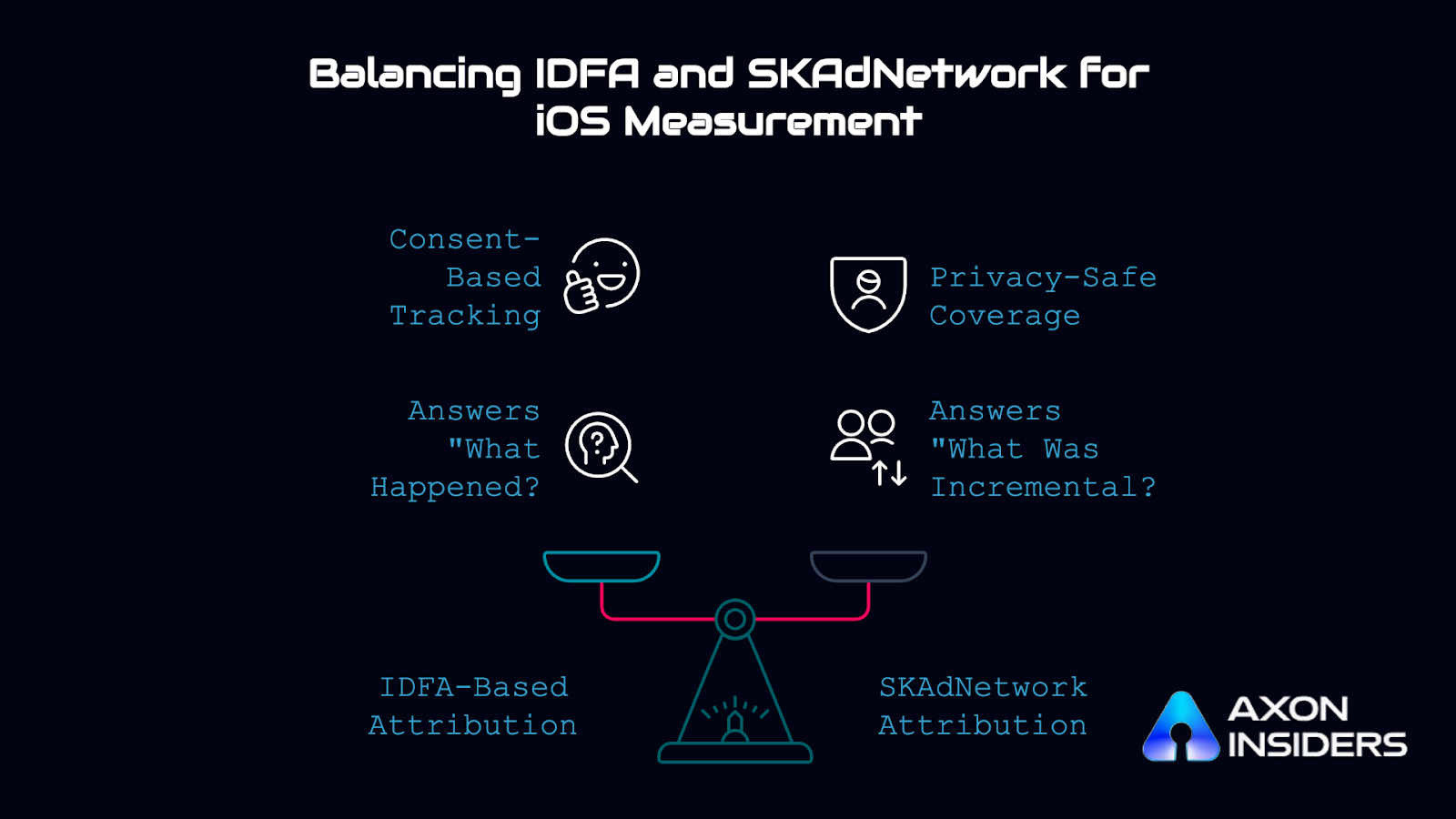
- IDFA provides deterministic insight for users who opt in
- SKAdNetwork provides privacy-safe, aggregated attribution for users who do not
Each system answers different questions.
IDFA helps you understand behavior within a consented subset of users, including detailed conversion paths and faster feedback on performance.
SKAdNetwork helps you understand overall campaign performance across a broader audience, even when user-level tracking is not available.
Treating them as competing systems creates blind spots. Treating them as complementary provides a more complete and reliable view of performance.
How IDFA fits into modern iOS measurement
In 2026, iOS measurement is layered by necessity.
Most mature advertisers rely on:
- IDFA-based attribution where consent exists
- SKAdNetwork attribution for privacy-safe coverage
- Incrementality testing to validate net-new impact
- First-party analytics for product and engagement insights
IDFA answers:
- What happened for users who allowed tracking?
It does not answer:
- What happened overall?
- What was incremental?
- What scaled beyond consented users?
Those questions require additional systems.
Where IDFA still adds strategic value
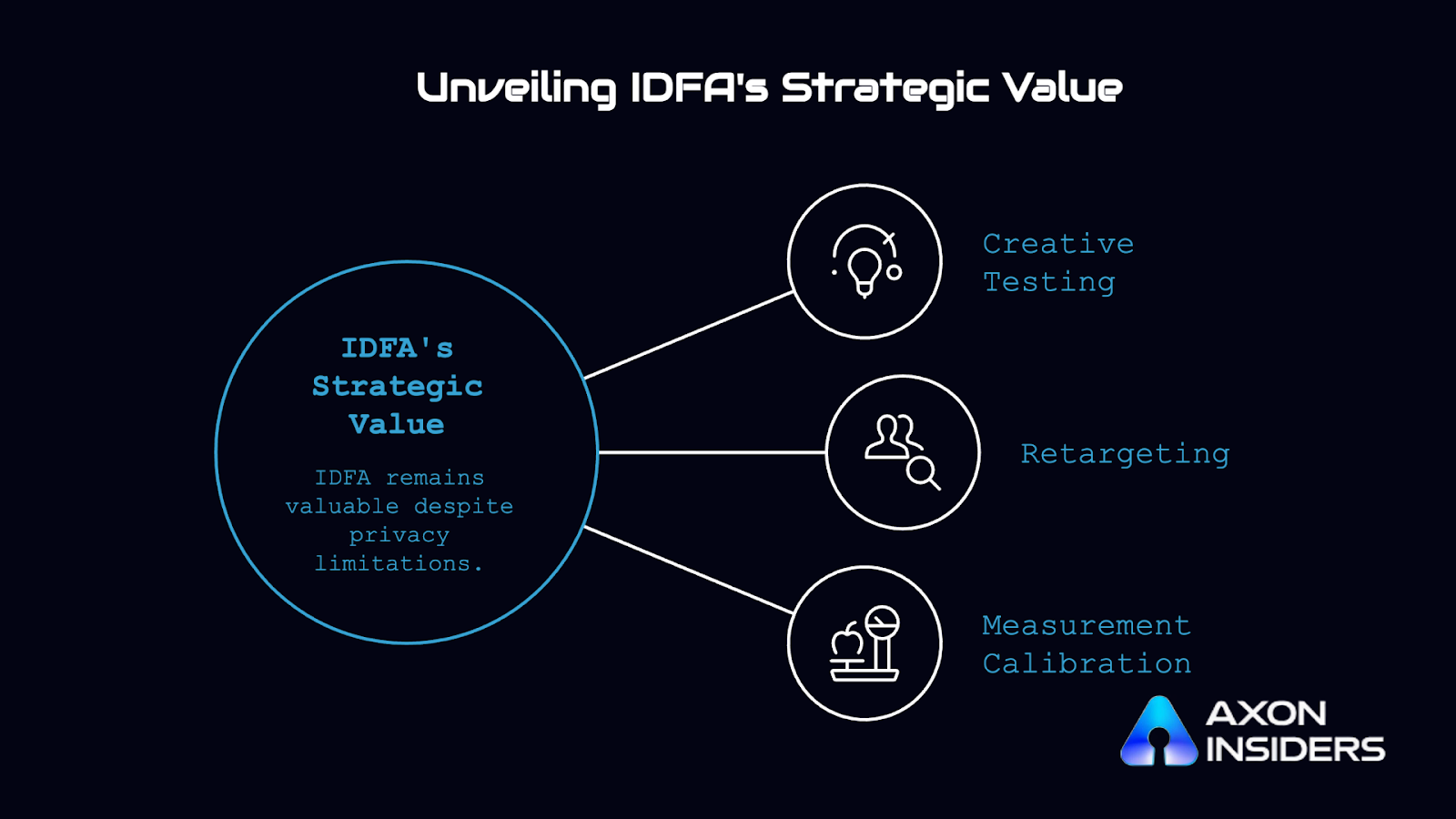
Despite its limitations, IDFA remains useful in several scenarios.
Creative testing
IDFA-enabled traffic often provides faster signals for creative iteration. While not fully representative, it can inform creative direction.
Retargeting
When users opt in, IDFA allows compliant re-engagement strategies that are not possible under SKAdNetwork alone.
Measurement calibration
Some teams use IDFA traffic as a reference point to help interpret aggregated or modeled results, not as a source of absolute truth.
The risk of over-relying on IDFA
The biggest mistake advertisers make in 2026 is treating IDFA data as representative of the entire audience.
Optimizing exclusively on IDFA traffic can:
- Distort performance interpretation and create bias toward consented users
IDFA data only reflects users who opted in to tracking, who may behave differently from the broader audience. Using this subset as a proxy for total performance can lead to misleading conclusions. - Bias spend toward lower-funnel users
Opted-in users are often more engaged or further along in the conversion process. Optimizing around this group can push campaigns toward audiences that are easier to convert, but not necessarily incremental. - Underinvest in upper-funnel activity
Upper-funnel interactions are less likely to be captured through deterministic signals. If decisions are based only on IDFA data, awareness-driving efforts may appear less valuable and receive less budget. - Misrepresent true incrementality
IDFA-based attribution can over-credit conversions that may have happened anyway, especially among highly engaged users. Without broader measurement, it becomes difficult to separate true lift from existing demand.
IDFA should inform decisions, not dictate them.
How Axon operates across consent states
Axon is designed for mixed-signal environments.
In practice:
- IDFA is used where users opt in via tracking URL macros
- SKAdNetwork attribution covers users who do not
- Incrementality testing and modeling help validate real impact across both groups
Rather than assuming deterministic attribution as the default, Axon treats IDFA as one signal among many.
This reduces bias and allows advertisers to scale iOS campaigns without depending on a single identifier.
Axon always performs best when campaigns are optimized toward clearly measurable installs or post-install conversion events.
How to Navigate Privacy-First Advertising with Axon
IDFA is no longer the foundation of iOS advertising, but it is still an important part of the stack.
In 2026:
- IDFA exists only with user consent
- Its coverage is partial by design
- Its value depends on how it is combined with other signals
Advertisers who succeed are those who stop chasing universal identifiers and start building measurement systems that work across consent states.
Axon is built for that reality. It supports IDFA where it exists, SKAdNetwork where it does not, and incrementality where it matters most.
If you want deeper insight into how mobile marketers are navigating privacy-first advertising in practice, consider joining Axon Insiders.
Axon Insiders is a private community of performance marketers, growth leaders, and media practitioners focused on scaling mobile ads in the modern era. You’ll find:
- Conversations about attribution strategies and measurement solutions
- Examples of IDFA-aware optimization frameworks
- Peer insight on SKAN implementations, incrementality testing, and creative performance
- Early access to research, sessions, and invite-only content
For mobile advertisers facing measurement fragmentation in 2026, Axon Insiders is where the conversation moves from theory to practice.
Learn more and request access.
FAQs
1. What does IDFA stand for?
IDFA is the Identifier for Advertisers, a device-level identifier on iOS used for advertising and attribution.
2. Is IDFA still available on iOS?
Yes, but only when a user has opted in to tracking via Apple’s App Tracking Transparency prompt.
3. Can IDFA still be used for retargeting?
Yes, when tracking permission is granted, IDFA can support deterministic retargeting and frequency control.
4. What happens if a user declines ATT?
Without tracking consent, the IDFA is unavailable, and privacy-safe systems like SKAN or modeling must be used instead.
5. How is IDFA used on Axon campaigns?
Axon supports IDFA through campaign tracking macros that capture the identifier when available, complementing privacy-safe attribution methods.
.png)
Learn the major differences between Discovery Campaigns and Prospecting Campaigns on Axon by AppLovin.
Learn how IDFA works in 2026, when it applies, why user consent matters, and how it fits into modern iOS advertising with SKAN, modeling, and Axon.
.png)