

What is SKAN? iOS Attribution Guide for Advertisers 2026
.png)
What is SKAN? An Advertiser’s Guide for 2026
If you run mobile app campaigns on iOS, SKAdNetwork (SKAN) is no longer optional. It is the default attribution framework Apple provides for privacy-safe app install measurement. While most advertisers are familiar with the term, fewer teams truly understand how SKAN works in practice, what it can realistically tell you, and how to use it effectively alongside modern media platforms.
In 2026, success with SKAN does not come from chasing perfect attribution. It comes from understanding its constraints, designing your measurement strategy accordingly, and using platforms that are built to operate within those limits.
This guide explains what SKAN is, how it works today, common mistakes advertisers still make, and how SKAN attribution fits into campaign optimization on Axon.
What is SKAN?
SKAdNetwork (SKAN) is Apple’s privacy-preserving attribution framework for iOS app advertising. It allows advertisers and ad networks to measure whether an ad resulted in an app install and limited post-install activity, without sharing user-level identifiers like IDFA.
Instead of user-level event data, SKAN provides aggregated postbacks that summarize campaign-level outcomes. These postbacks are delayed notifications sent by Apple that report grouped results such as installs or conversion value ranges, rather than individual user actions. In other words, you receive summarized performance signals across many users instead of tracking what a specific user did.
Apple controls the attribution process and enforces privacy thresholds before releasing any data.
At a high level, SKAN is designed to answer one core question:
Did this ad campaign drive installs and meaningful post-install outcomes, without identifying the user
Why SKAN exists
Historically, mobile attribution relied on deterministic identifiers and real-time user-level data. That approach no longer aligns with Apple’s privacy standards.
SKAN exists to:
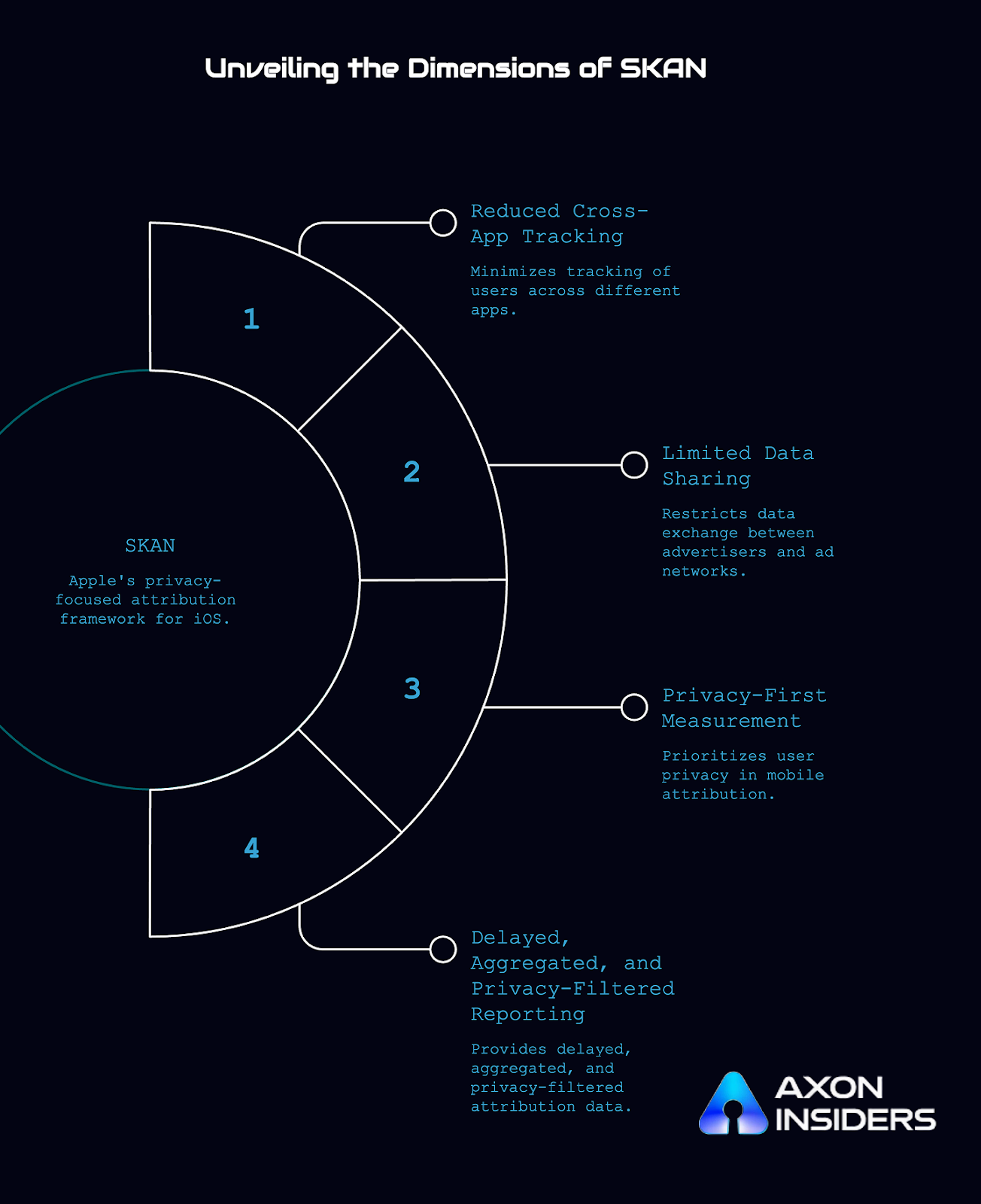
- Reduce cross-app tracking
- Limit data sharing between advertisers and ad networks
- Preserve measurement in a privacy-first ecosystem
The result is a system that favors delayed, aggregated, and privacy-filtered reporting over granular user journeys. This tradeoff is intentional, and it shapes how advertisers must think about optimization.
How SKAN works in practice
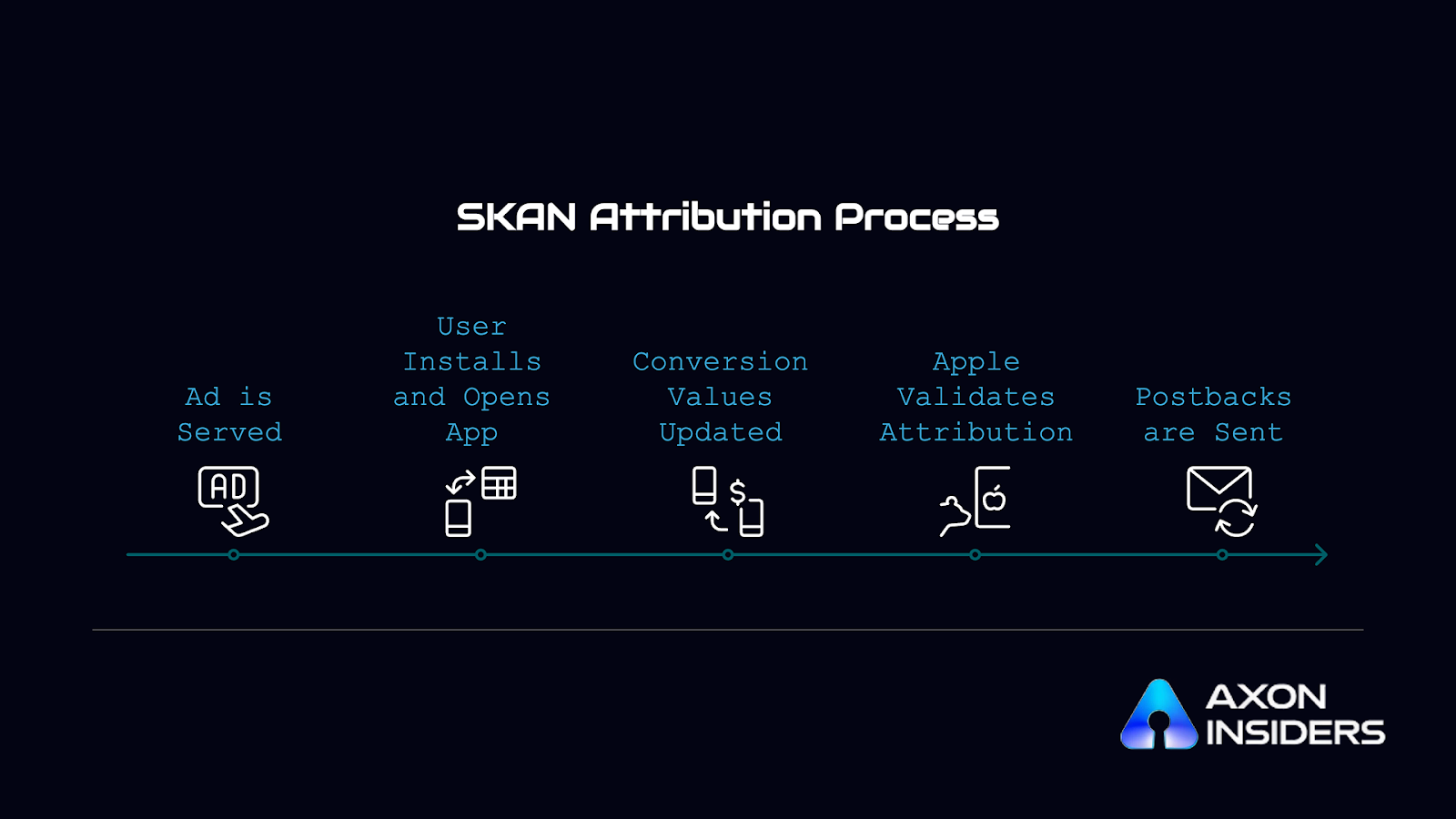
SKAN attribution follows a defined flow:
- An ad is served
The ad network signs the ad interaction using its SKAdNetwork ID. - The user installs and opens the app
If the app has SKAN configured correctly, it can begin updating conversion values. - Conversion values are updated
The advertiser defines which in-app events or milestones update conversion values during specific time windows. - Apple validates attribution
Apple determines the winning attribution and applies privacy rules. - Postbacks are sent
Apple sends aggregated postbacks to the ad network, which are then passed to the advertiser directly or through a mobile measurement partner (MMP).
At no point does SKAN expose user-level identifiers or raw event logs.
SKAN in 2026: what matters now
While Apple continues to refine SKAN, most advertisers in 2026 are still operating around the SKAN 4 model and its core concepts.
Multiple conversion windows
SKAN supports multiple post-install windows, which are defined periods of time after a user installs an app during which their behavior can be measured and encoded into conversion values.
Instead of capturing all activity in the first 24 hours, SKAN now allows advertisers to observe and report on user behavior across multiple timeframes after install. Each window can generate its own postback, providing separate signals for early, mid, and later engagement.
This matters because user value does not always show up immediately.
Early windows can capture signals like app opens or onboarding completion. Later windows can reflect deeper engagement, such as purchases, subscriptions, or retention. By spreading measurement across multiple windows, advertisers get a more complete view of user quality over time.
This reduces pressure to encode all value into the first 24 hours, which was one of the main limitations of earlier SKAN versions.
Conversion values are the core signal
Conversion values remain the primary way advertisers communicate post-install quality back to SKAN.
The challenge is not technical. It is strategic.
Your conversion value mapping should reflect:
- Meaningful product milestones
- Signals that influence optimization decisions
- Events that occur with enough volume to survive privacy thresholds
Overly complex mappings often result in sparse or unusable data.
Privacy thresholds are real
SKAN enforces anonymity thresholds. When volume is too low, Apple may return coarse values or suppress detail entirely.
This means:
- Small, highly fragmented campaigns often perform poorly from a measurement perspective
- Aggregation is not a flaw. It is a requirement
What SKAN can and cannot tell you
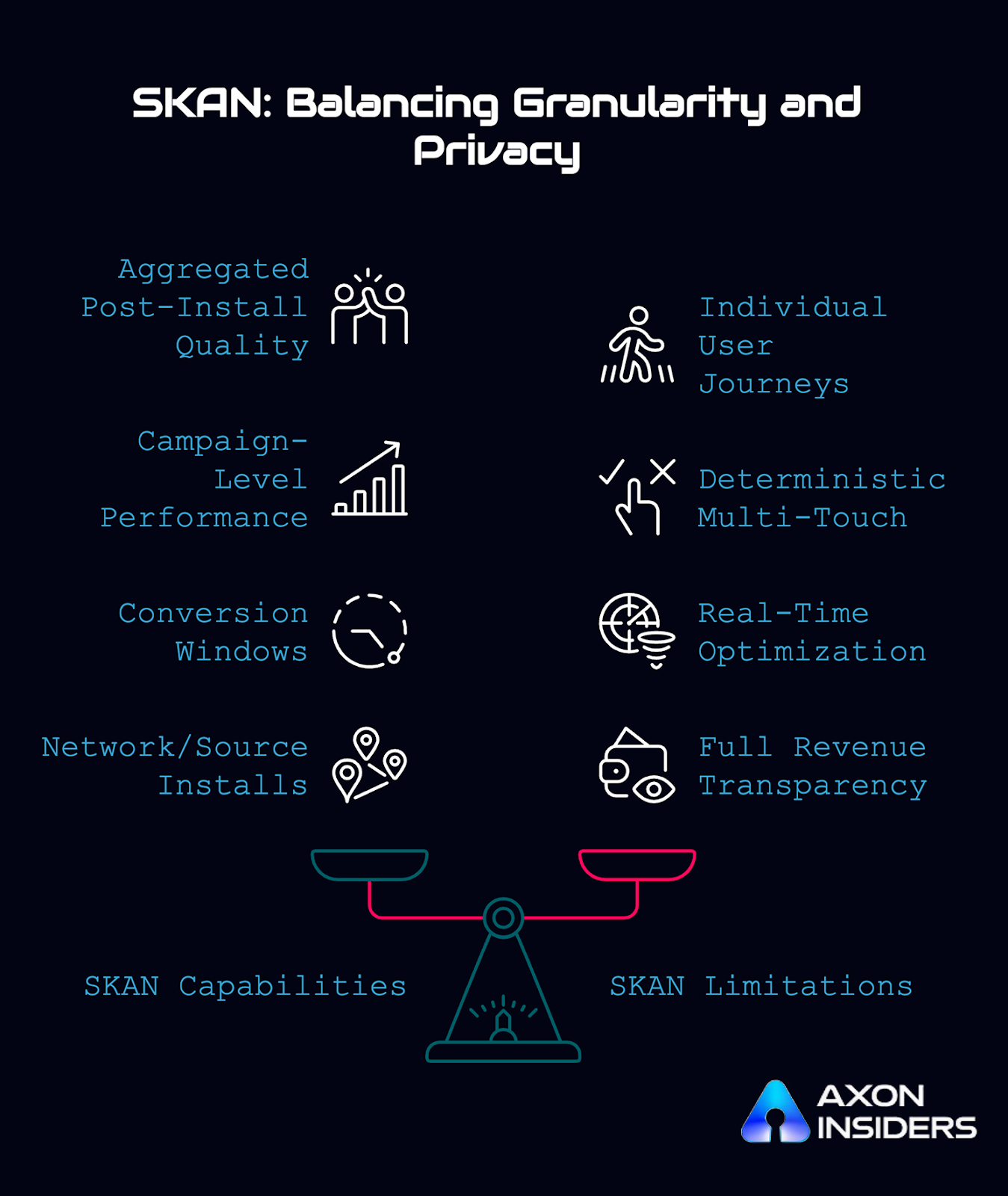
SKAN can tell you:
- Which network or source drove installs
- Campaign-level performance trends
- Aggregated post-install quality signals
- Performance across defined conversion windows
SKAN cannot tell you:
- Individual user journeys
- Deterministic multi-touch attribution
- Real-time optimization signals
- Full revenue transparency at the individual level
Understanding this boundary is critical. SKAN is not broken because it lacks granularity. It is designed that way.
Common SKAN mistakes advertisers still make
Treating SKAN as a reporting checkbox
SKAN is not something you “turn on” and forget. Your results are only as good as your conversion strategy.
If your conversion values do not map to real decisions, your SKAN data will not be actionable.
Overengineering conversion values
More states do not equal better insight. Many teams design conversion maps that are too complex to maintain or explain.
Simple, durable milestones outperform fragile, hyper-granular logic almost every time.
Expecting SKAN to replace all measurements
SKAN is one input, not the entire system. Teams that succeed combine SKAN with:
- First-party analytics
- Incrementality testing
- Modeled performance analysis
Where SKAN fits in modern mobile measurement
SKAN reflects a broader industry shift toward privacy-safe attribution. Similar approaches exist on the web, such as Google’s Attribution Reporting API, which also limits user-level tracking in favor of aggregated outcomes.
In 2026, modern measurement is layered:
- SKAN for iOS attribution
- Experiments to validate lift
- First-party data for product insight
Advertisers who accept this model move faster than those trying to recreate the past.
How Axon uses SKAN
Axon does not implement SKAdNetwork directly at the SDK level. Instead, Axon supports SKAN through integrations with mobile measurement partners (MMPs).
This reflects how SKAN typically operates across the ecosystem. Apple sends SKAN postbacks to ad networks, and advertisers often rely on MMPs to process, validate, and organize that data before sharing it with their media platforms. Axon consumes SKAN-attributed data from the MMP to inform reporting and optimization.
Axon performs best when campaigns are optimized toward clearly measurable installs or post-install conversion events.
The role of the MMP
When running iOS campaigns on Axon, advertisers connect an MMP such as AppsFlyer to handle SKAN attribution.
This is standard practice across most ad platforms.
The MMP:
- Receives SKAN postbacks from Apple
- Validates and processes conversion values
- Shares SKAN-attributed data with connected platforms, including Axon
Axon relies on this data to evaluate performance within SKAN constraints.
Required configuration for SKAN on Axon
To properly leverage SKAN with Axon:
- Connect your MMP to Axon before launching iOS campaigns
- Enable SKAN transaction ID sharing in your MMP settings
- Confirm that SKAdNetwork attribution is active for your iOS app
For example, in AppsFlyer, this typically involves enabling the option to share SKAN transaction IDs for iOS apps.
If this configuration is missing, SKAN postbacks may still exist at the MMP level, but Axon will not be able to use them for optimization.
How Axon uses SKAN data
Once properly configured:
- SKAN postbacks and conversion values flow from the MMP to Axon
- This data contributes to campaign-level performance reporting
- Axon uses SKAN-attributed conversion data and modeled performance signals to optimize toward installs and downstream events
Axon operates within SKAN’s limitations by design. Optimization is driven by trends, modeled outcomes, and incrementality, not user-level tracking.
Why this model works in 2026
SKAN defines the measurement rules. MMPs manage attribution plumbing. Axon focuses on performance and optimization within those rules.
This separation of responsibilities is intentional and effective:
- Privacy requirements are respected
- Attribution remains compliant
- Advertisers still gain actionable insight
Rather than attempting to bypass SKAN constraints, Axon is built to work with them.
How Teams Design Conversion Strategies with Axon
Understanding SKAN is only the first step. The real advantage comes from seeing how experienced teams design conversion strategies, structure campaigns, and validate performance inside SKAN’s constraints.
Axon Insiders is a private community where growth leaders, app marketers, and performance teams share how they are navigating privacy-first measurement, SKAN optimization, and incrementality in real-world campaigns.
Inside Axon Insiders, you’ll find:
- Practical insights on running iOS acquisition under SKAN
- Examples of conversion value strategies that scale
- Perspectives on incrementality testing and modeled measurement
- Early access to Axon research, product updates, and invite-only sessions
If SKAN is shaping your 2026 strategy, Axon Insiders is where the conversation moves from theory to execution.
Learn more and request access.
FAQs
1. What does SKAN stand for?
SKAN stands for SKAdNetwork, Apple’s privacy-safe framework for attributing iOS app installs and limited post-install activity without user-level identifiers.
2. How does SKAN affect iOS campaign reporting?
SKAN shifts attribution from user-level data to aggregated postbacks, meaning advertisers receive campaign summaries instead of individual user journeys.
3. What are conversion values in SKAN?
Conversion values are numeric signals your app updates post-install to communicate quality or engagement milestones back to SKAN, which then influences the postbacks you receive.
4. Why do some SKAN campaigns return limited data?
Apple enforces privacy thresholds. When volume is low or segmentation is too granular, detailed postback data may be coarse or suppressed.
5. Do I still need an MMP with SKAN?
Yes. SKAN postbacks are often routed through a mobile measurement partner (MMP), which processes and forwards the aggregated data to platforms like Axon for reporting and optimization.
.png)
Learn the major differences between Discovery Campaigns and Prospecting Campaigns on Axon by AppLovin.
.png)
Learn how IDFA works in 2026, when it applies, why user consent matters, and how it fits into modern iOS advertising with SKAN, modeling, and Axon.