

Mobile Ad Costs in 2026: Benchmarks, Factors, and Strategies

Mobile Ad Costs in 2026: What Advertisers Need to Know
Mobile advertising in 2026 is both more expensive and more complex than ever. Rising acquisition costs, privacy restrictions, and fragmented customer journeys have forced advertisers to rethink how they measure and manage spend. Understanding ad costs isn’t just about knowing CPMs or CPCs — it’s about knowing how those costs translate into incremental growth.
Why Mobile Advertising Costs Matter
Mobile advertising costs are the pulse of growth. Every CPM, CPC, CPI, or CPA is a reflection of how crowded the market is, how valuable the audience has become, and how much confidence advertisers have in their campaigns. Rising costs matter because they directly shape ROI. If spend isn’t tied to incremental growth, higher prices quickly eat into margins. In 2026, the smartest advertisers aren’t chasing “cheap clicks.” They’re chasing proof that every dollar spent is creating new customers, stronger lifetime value, and measurable lift.
How Much Do Mobile Ads Cost in 2026?
Benchmarks from 2025 give us a clear trajectory into 2026. Costs are climbing, but the story behind them is more nuanced:
- CPM (Cost per Mille): In 2025, CPMs ranged from $4–10 on YouTube, $13.57 on Facebook, and $26.91 on LinkedIn. Forecasts suggest another 5–10% rise in 2026 as privacy restrictions reduce targeting precision and competition intensifies.
- CPC (Cost per Click): CPCs averaged $2.69 on Google Search, $1.88 on Facebook, and $5.58 on LinkedIn. Expect modest increases in 2026, especially in finance, legal, and B2B verticals where competition is fierce.
- CPI (Cost per Install): Gaming apps typically saw $1–$5 CPI, while finance apps ranged $5–$10. Attribution complexity and SKAN limitations are expected to push CPI higher in 2026.
- CPA (Cost per Action): CPAs in 2025 ranged from $21.98 on Facebook to $15–$350 on LinkedIn, depending on industry. In 2026, CPAs are forecast to rise as advertisers demand more qualified leads and conversions.
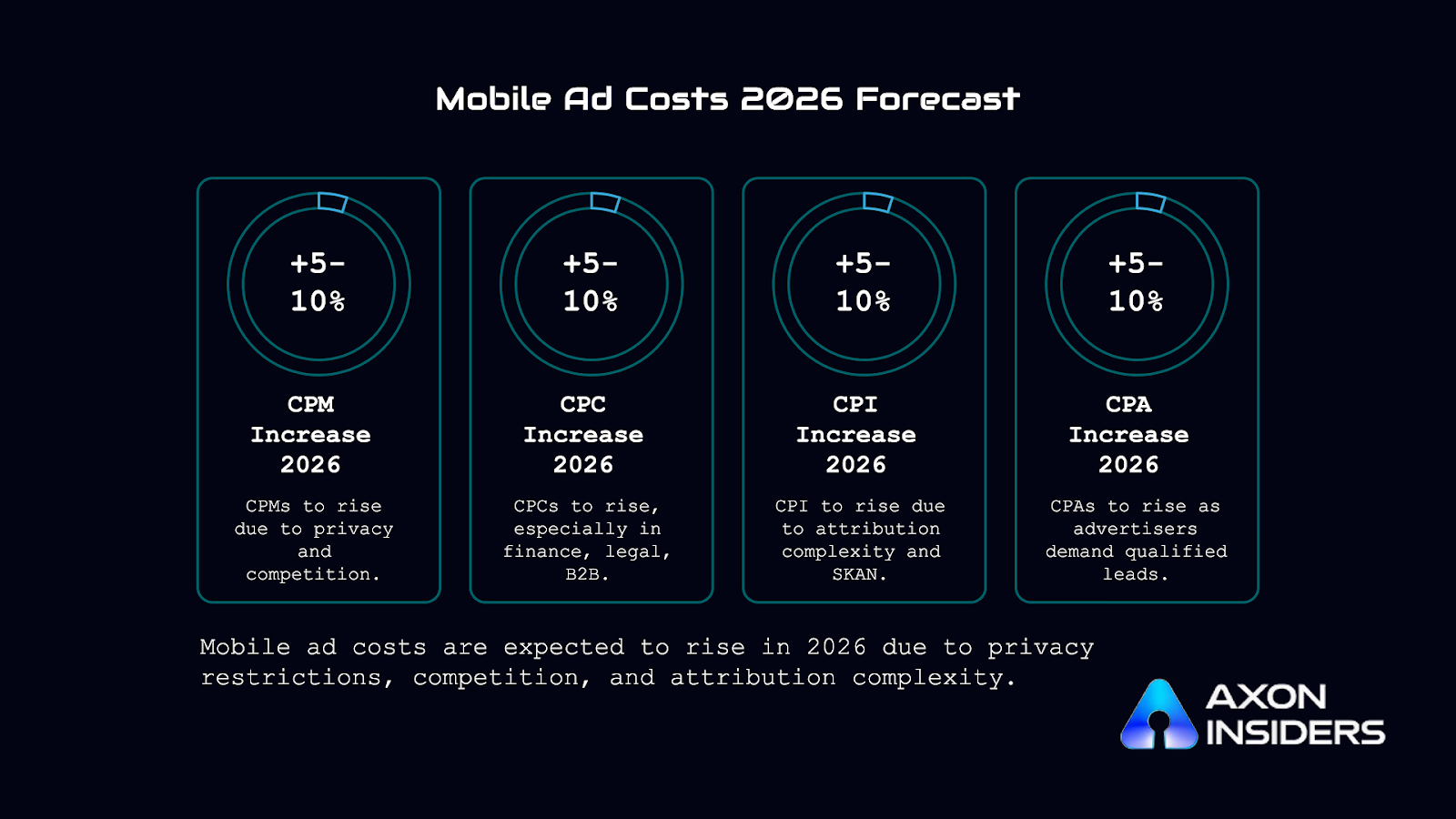
The headline isn’t just “costs are up.” It’s that efficiency now depends on incrementality, proving that spend is driving conversions that wouldn’t have happened otherwise.
What Factors Influence Mobile Advertising Costs?
Mobile ad costs don’t just drift upward on their own... they’re shaped by a web of forces that advertisers need to understand if they want to keep spending efficiently.
For 2026, five dynamics stand out:
1. Ad Format
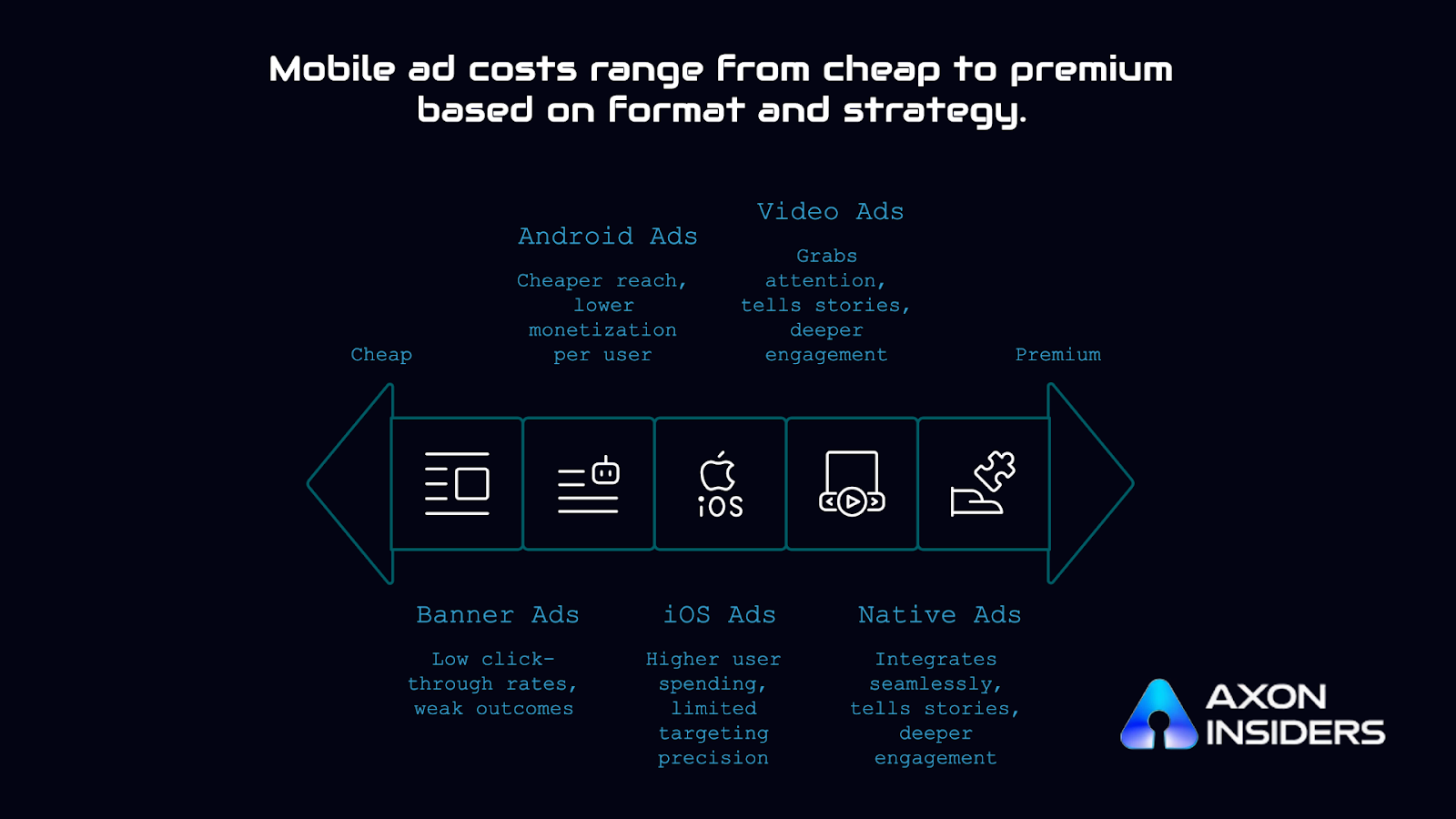
The format you choose sets the tone for both cost and performance. Video and native ads sit at the premium end because they grab attention and tell stories in ways banners never can. A rewarded video in a gaming app might cost more, but it often delivers deeper engagement and higher retention. Banner ads, on the other hand, remain cheap but are notorious for low click‑through rates. The trade‑off is clear: pay more for formats that spark intent, or save upfront and risk weaker outcomes.
2. Platform Differences
The iOS vs. Android divide is still alive. iOS ads consistently cost more, partly because Apple users spend more and partly because ATT rules limit precision targeting. Android offers cheaper reach, but monetization per user is lower. Smart advertisers don’t pick one over the other, they design platform‑specific strategies, leaning into iOS for high‑value customers and using Android for scale.
3. Industry and Competition
Verticals dictate the battlefield. Finance, legal, and B2B advertisers face some of the steepest CPCs because customer lifetime values are massive and competition for qualified leads is relentless. Gaming and e‑commerce, by contrast, often enjoy lower rates but rely on volume and retention to make the economics work. The lesson: don’t benchmark against “average” CPMs or CPCs; benchmark against your industry peers.
4. Seasonality and Market Trends
Timing can double or halve your costs. Q4 holidays, Prime Day, Black Friday, and back‑to‑school are notorious for driving CPMs through the roof as every brand fights for the same eyeballs. Even smaller seasonal spikes: Valentine’s Day for retail, summer travel for hospitality; can distort costs. The best advertisers plan around these cycles, either leaning in when demand is highest or shifting spend to quieter periods where efficiency improves.
5. Privacy and Attribution Changes
The biggest disruptor is still privacy regulation. Apple’s ATT and SKAN frameworks have made deterministic attribution a relic. Advertisers now pay more for impressions while relying on modeled data to measure impact. CPMs rise because targeting precision falls, and attribution gets murkier. In 2026, the only way to cut through the fog is with incrementality testing, proving that spend is driving conversions that wouldn’t have happened otherwise.
How to Measure ROI and Control Mobile Ad Spend
In 2026, advertisers can’t afford to treat ROI as a simple equation. Rising CPMs and stricter privacy rules mean every dollar must be tied to incremental outcomes. Measurement has shifted from surface‑level metrics to a layered framework that balances efficiency, quality, and long‑term value.
ROAS (Return on Ad Spend)
- Traditional ROAS measures revenue generated per dollar spent, but it often inflates performance by counting conversions that would have happened anyway.
- Incremental ROAS (iROAS) strips away that noise, focusing only on conversions directly influenced by ads. This is now the gold standard for efficiency.
- Example: A campaign showing $5 ROAS might drop to $3 iROAS once incrementality is applied, but that $3 is the real growth you can scale with confidence.
CPP (Cost per Purchase)
- CPP is critical for direct commerce campaigns where the goal is driving transactions.
- It highlights whether ad spend is efficient at converting intent into actual purchases, not just clicks or installs.
- In 2026, CPP is often paired with AOV (Average Order Value) to ensure campaigns aren’t just driving cheap purchases but profitable ones.
CPI (Cost per Install)
- Still relevant for app growth, but CPI alone is misleading.
- Advertisers now pair CPI with retention rates and LTV (Lifetime Value) to see whether installs translate into sustainable revenue.
- Example: A $3 CPI looks efficient until you realize only 10% of users are active after 30 days.
Supporting Metrics
- CTR (Click‑Through Rate): Indicates creative resonance, but high CTR without conversions is vanity.
- Conversion Rate: Shows how well campaigns turn intent into action.
- Page Depth & Engagement: Reveal whether users are exploring beyond the landing page, a proxy for genuine interest.
Together, these metrics provide context... they don’t prove ROI alone, but they help diagnose why spend is or isn’t efficient.
Tools for Tracking and Optimization
Advertisers rely on a stack of platforms to consolidate spend, attribution, and revenue data across mobile apps and ecommerce environments.
A- Mobile Measurement & Attribution
- Firebase
Tracks in-app events, retention, funnels, and user engagement. Often used for product analytics and behavioral insights within apps. - AppsFlyer
Provides multi-touch attribution modeling, SKAN reporting, incrementality testing capabilities, and cross-channel measurement for mobile campaigns. - RevenueCat
Designed for subscription apps, RevenueCat measures renewals, churn, lifetime value (LTV), and subscription revenue performance across platforms.
B- Ecommerce & Incrementality Measurement
- Northbeam
An ecommerce attribution and media mix modeling platform that helps brands measure blended performance, incrementality, and cross-channel impact — particularly across Meta, Google, TikTok, and marketplaces like Amazon. - Triple Whale
Popular among Shopify brands, Triple Whale centralizes ad spend, revenue, MER, and customer data into a unified dashboard for performance analysis. - Haus
An incrementality testing platform focused specifically on geo-lift and controlled experiments for ecommerce brands. - Rockset / Custom Data Warehouses (e.g., Snowflake + Looker)
Many growth teams build internal measurement systems to combine paid media data, Shopify sales, subscription metrics, and marketplace revenue into a unified performance view.
The Strategic Layer
Controlling mobile ad spend in 2026 isn’t about cutting costs — it’s about proving efficiency and reallocating budgets toward incremental growth. Advertisers who succeed:
- Benchmark campaigns on iROAS, not vanity ROAS.
- Pair CPI with retention and LTV to avoid chasing empty installs.
- Use CPP and AOV together to ensure purchases are profitable.
- Build feedback loops where incrementality insights feed back into bidding and creative optimization.
What’s the Best Way to Manage Mobile Ad Costs?
Managing mobile ad costs in 2026 requires more than just watching CPMs and CPCs tick upward; it demands a system built for clarity, efficiency, and scale. Advertisers need tools that don’t just report spend, but actively optimize it in real time, even under the constraints of privacy rules and fragmented attribution. This is where Axon by AppLovin enters the picture: a platform designed to replace guesswork with predictive intelligence, transparent billing, and incrementality‑driven optimization.
Why Traditional Approaches Fall Short
For years, advertisers relied on manual bidding, fragmented attribution tools, and user‑level data to control spend. In 2026, those methods are increasingly limited:
- Manual bidding can’t keep pace with real‑time market shifts.
- Fragmented attribution tools often miss halo effects and cross‑channel impact.
- Reliance on device identifiers is no longer viable under ATT and SKAN privacy rules.
The result? Rising CPMs and CPCs, wasted spend, and dashboards that don’t reflect true incremental value.
How Axon by AppLovin Solves These Challenges
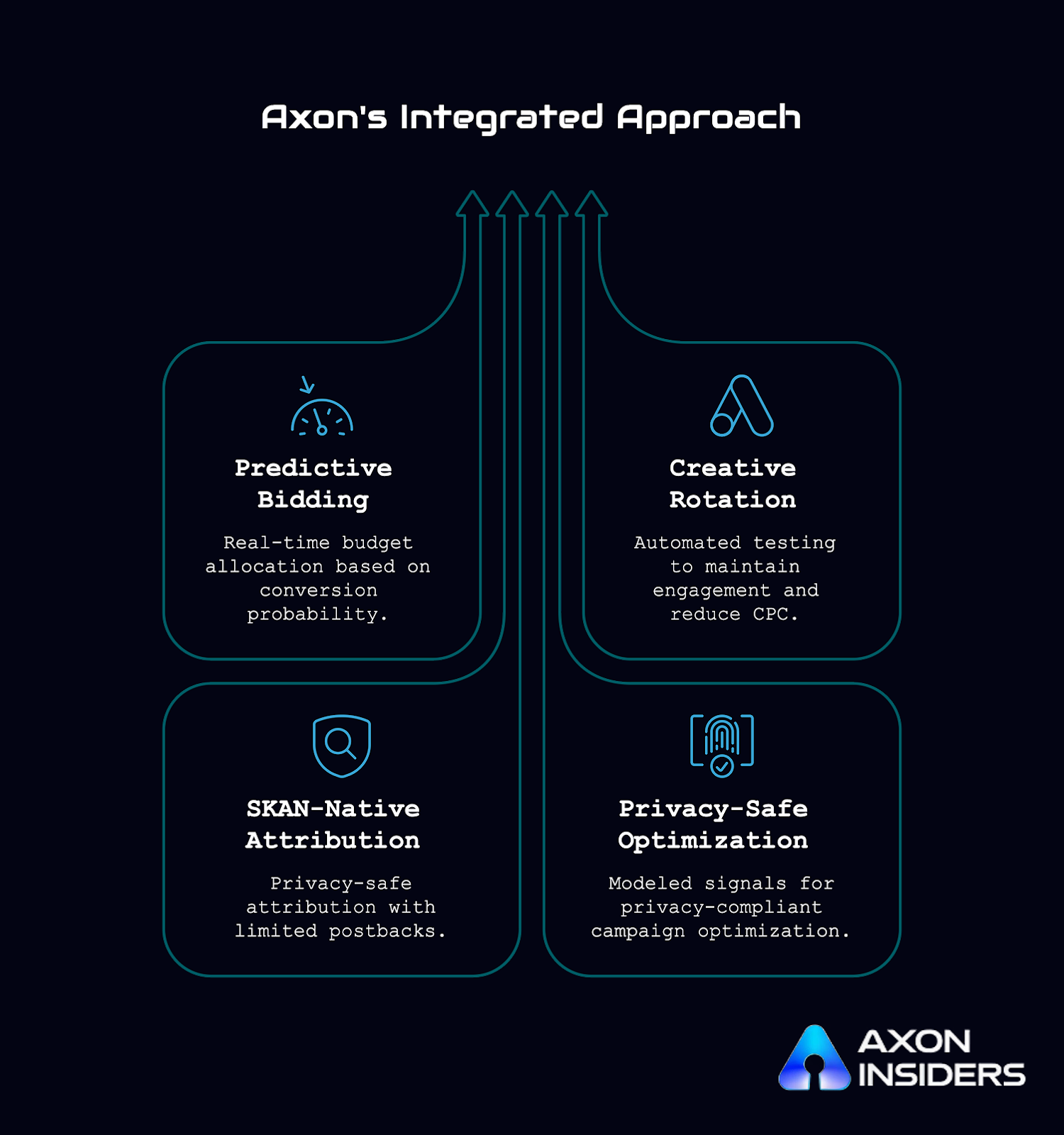
Axon was built to address these pain points head‑on, combining predictive bidding, creative intelligence, and privacy‑safe attribution into one system:
A- Predictive Bidding:
Axon reallocates spend in real time based on conversion probability, ensuring budgets flow toward impressions most likely to deliver incremental outcomes.
B- Creative Rotation:
Automated creative testing and rotation prevent fatigue, sustaining engagement and lowering effective CPC over time.
C- SKAN‑Compatible Attribution:
Axon’s attribution modeling works even with limited postbacks, giving advertisers clarity in a privacy‑restricted environment.
D- Privacy‑Safe Optimization:
Instead of relying on device identifiers, Axon uses modeled signals and incrementality data to optimize campaigns without compromising compliance.
E- Transparent Billing That Matches Strategy
Managing costs isn’t just about bidding — it’s also about clarity in how spend is charged. Axon’s prepay billing system ensures advertisers know exactly where their money is going:
- Cards are charged daily at 0:00 UTC for the day’s budget.
- If budgets increase mid‑day or new campaigns launch, charges adjust automatically.
- Unused funds roll forward into the account balance, so nothing is lost.
- Advertisers receive daily receipts and a monthly invoice detailing all spend and payments.
This transparency aligns perfectly with Axon’s optimization philosophy: no hidden costs, no guesswork, just clarity and control.
The Advantage for Performance Advertisers
By combining predictive bidding, creative rotation, SKAN‑native attribution, and transparent billing, Axon delivers:
- Lower wasted spend by reallocating budgets toward high‑probability conversions.
- Stronger ROAS through incrementality‑driven optimization.
- Attribution that reflects actual user value, not inflated last‑click metrics.
For performance advertisers, the advantage is simple: Axon turns rising mobile ad costs into scalable, measurable growth.
Key Takeaways for Advertisers in 2026
Mobile advertising in 2026 is shaped by rising costs, stricter privacy rules, and the demand for proof of incremental value. Success depends on understanding benchmarks, anticipating cost drivers, and adopting strategies that balance efficiency with scale.
CPM, CPC, CPI, and CPA are all trending upward, with video and premium formats commanding the highest rates. Finance and B2B face steep CPCs, while gaming and e‑commerce lean on retention and volume. Regional differences remain, with North America and Europe carrying higher CPMs than APAC and LATAM.
Costs are influenced by format choice, platform differences, and seasonality, while privacy frameworks like ATT and SKAN continue to reshape measurement. Advertisers must focus on iROAS, CPP, and LTV, rotate creatives to sustain engagement, segment audiences to reduce waste, and embrace contextual signals for privacy‑safe targeting.
This is where Axon by AppLovin stands out. By combining predictive bidding, creative rotation, SKAN‑native attribution, and privacy‑safe optimization, Axon gives advertisers a clearer, more reliable picture of campaign value — and the confidence to scale spend without second‑guessing ROI.
The future of mobile advertising isn’t about chasing cheaper CPMs; it’s about proving incremental growth and scaling with confidence. AxonInsiders gives you exclusive access to benchmarks, case studies, and playbooks from brands already navigating 2026’s cost landscape.
Join Axon Insiders today and learn how to turn rising ad costs into scalable, measurable growth.
.png)
Learn the major differences between Discovery Campaigns and Prospecting Campaigns on Axon by AppLovin.
.png)
Learn how IDFA works in 2026, when it applies, why user consent matters, and how it fits into modern iOS advertising with SKAN, modeling, and Axon.
.png)